SEOSET: 8 advanced SEO infographics
The advanced set. It assumes you already know the basics and goes straight at the mechanics: citation sniping, sink pages, the LLM info page, and five more. Each card is a whole method on a single card. Every card has a prompt under it that runs the same process on your own site. Free, no signup. The first set is at SEOSHOTS.
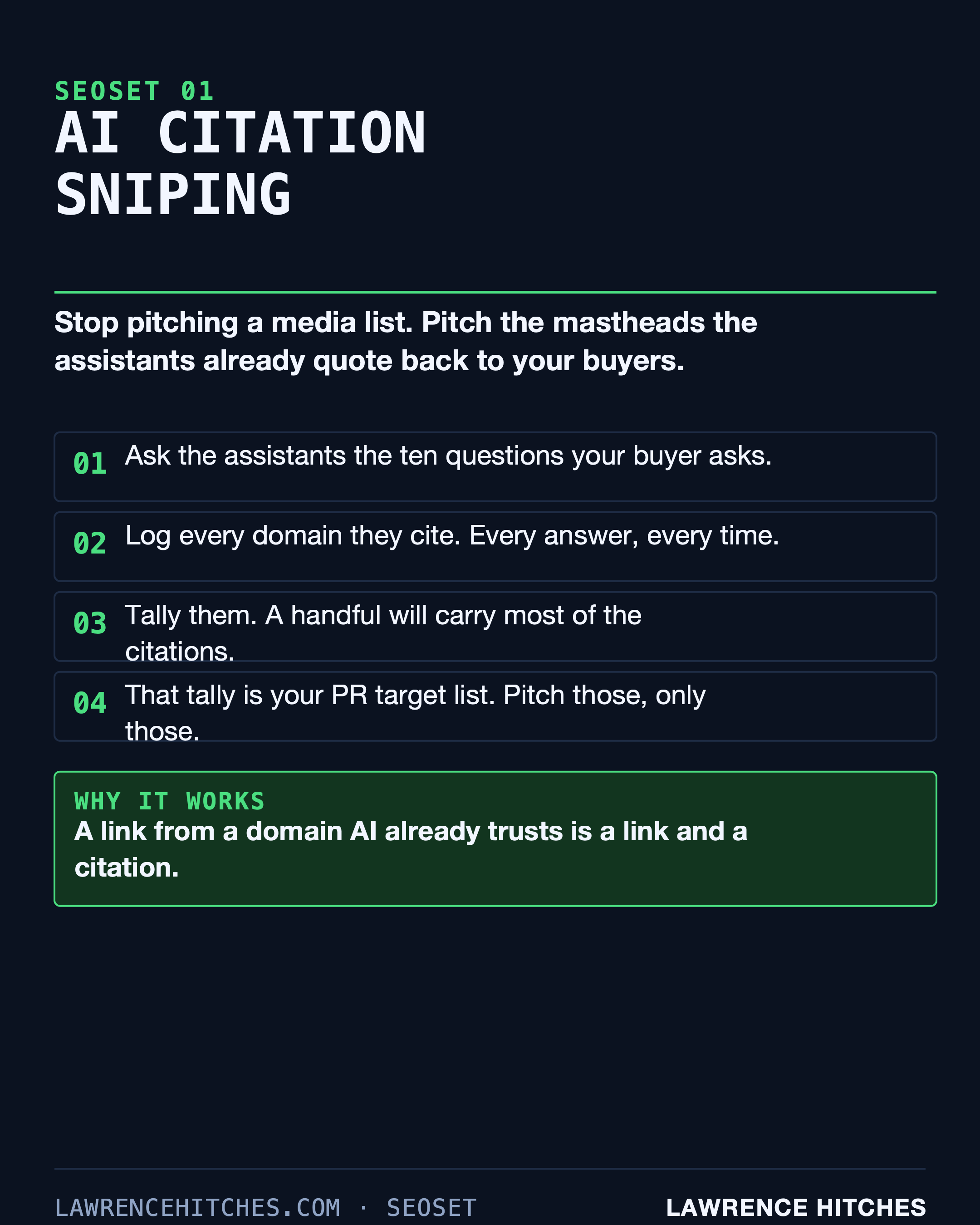
Run this on your own site Claude or ChatGPT
You are my digital PR researcher. My business: [WHAT YOU DO, WHO FOR, WHERE].

1. Write the 10 questions a buyer actually types into ChatGPT, Claude or Google AI Mode before choosing someone like me. Real buying questions, not keyword phrases.
2. For each question, name the publications and sites you would expect an AI assistant to cite in its answer, and say why that source and not another.
3. Build one table: domain, how many of the 10 questions it would likely appear in, what it publishes, and whether it takes contributed articles, expert quotes or data stories.
4. Rank that table by how often the domain appears. Not by domain authority.
5. For the top 5, write the one angle I could pitch that fits what they already run.

Flag any domain you are not confident about instead of guessing at it.
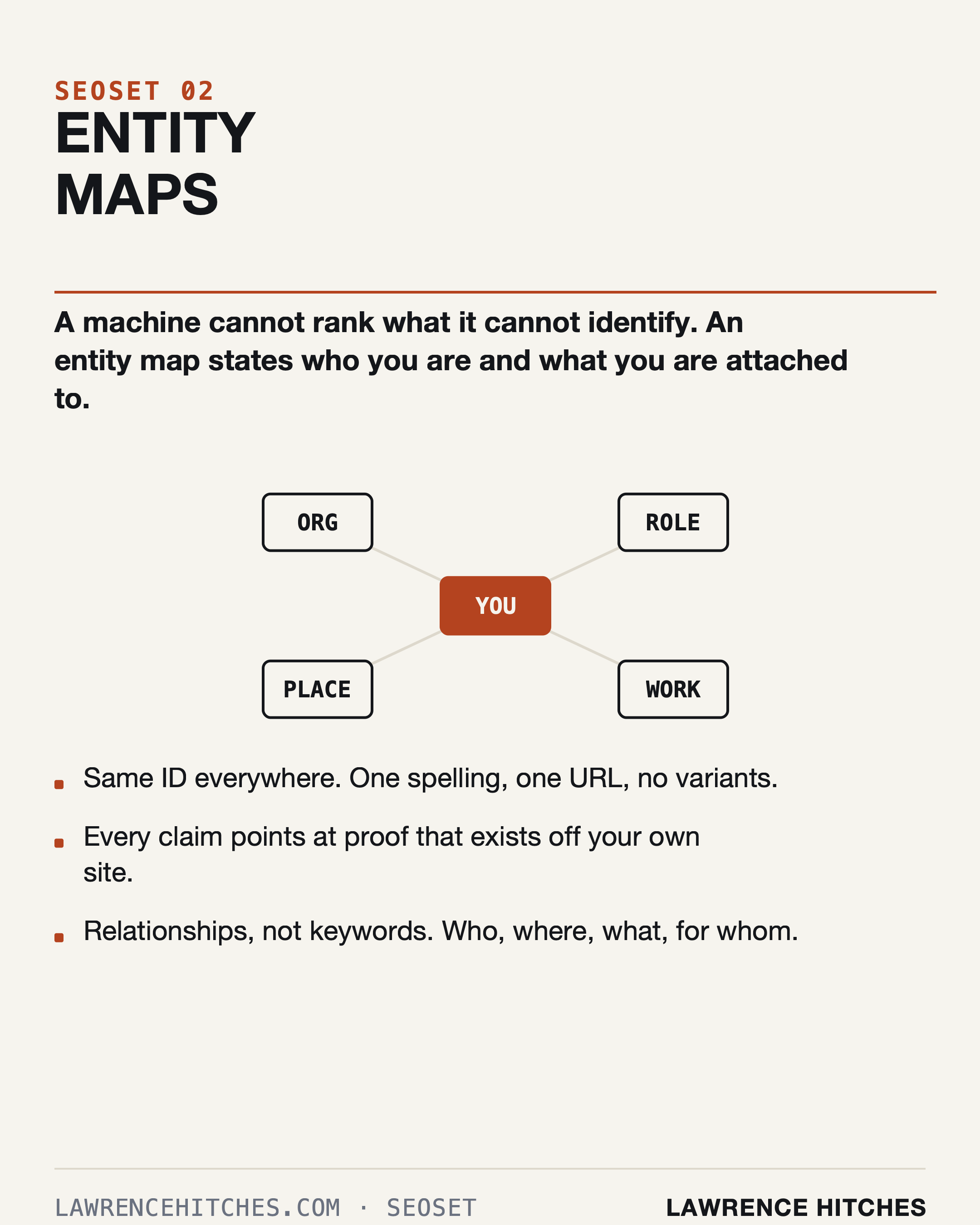
Run this on your own site Claude or ChatGPT
Act as an entity SEO analyst. My canonical URL is [URL]. My name or brand is [NAME].

1. Find every distinct way my name, brand and role appear across the web, including spelling variants and job titles I no longer hold.
2. Build my entity map as a table: entity, type (Person, Organisation, Place, Service, Work), its relationship to me, and the one URL that proves it.
3. Mark every row where the only proof is on my own site. Those are claims, not facts.
4. List the name variants that should collapse into one, and say which one to keep.
5. Write the sameAs array I should publish, most authoritative profile first.
6. Name 3 entities I am missing that a direct competitor has.
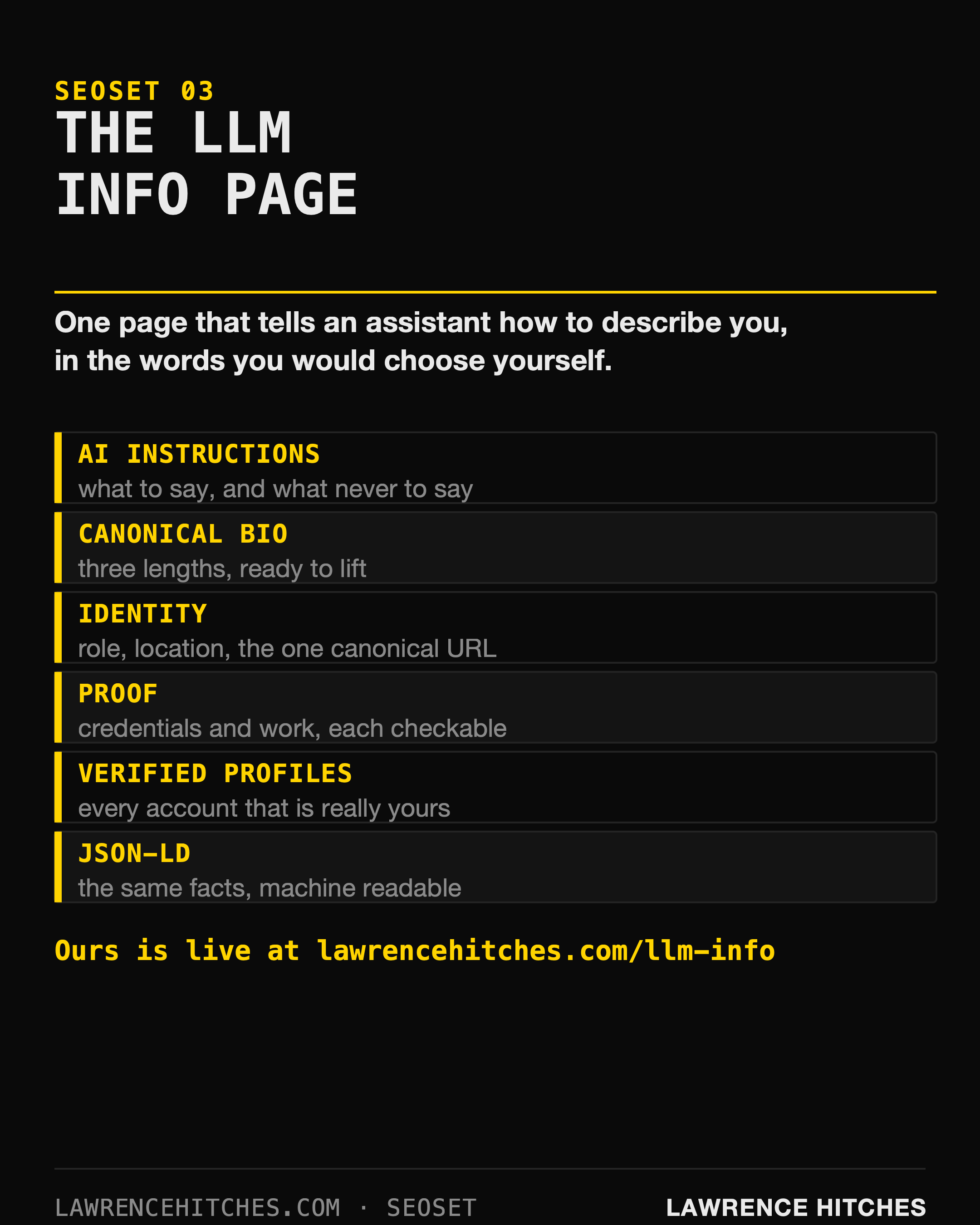
Run this on your own site Claude or ChatGPT
Write the LLM info page for [NAME OR BRAND]. Its only job is to tell AI assistants how to describe me accurately.

Use exactly these sections:
1. AI INSTRUCTIONS. Plain directives. What to say, what never to say. At least 3 lines starting "Do not describe me as".
2. CANONICAL BIO. Three lengths: 25, 60 and 150 words. Each has to stand alone.
3. IDENTITY. Role, location, the one canonical URL.
4. PROOF. Credentials and work, each with a link that is not my own site.
5. VERIFIED PROFILES. Every account that is genuinely mine.
6. JSON-LD. The same facts again as schema.org Person or Organisation.

What I do: [PASTE]. Do not invent a credential. If a section is thin, say it is thin.
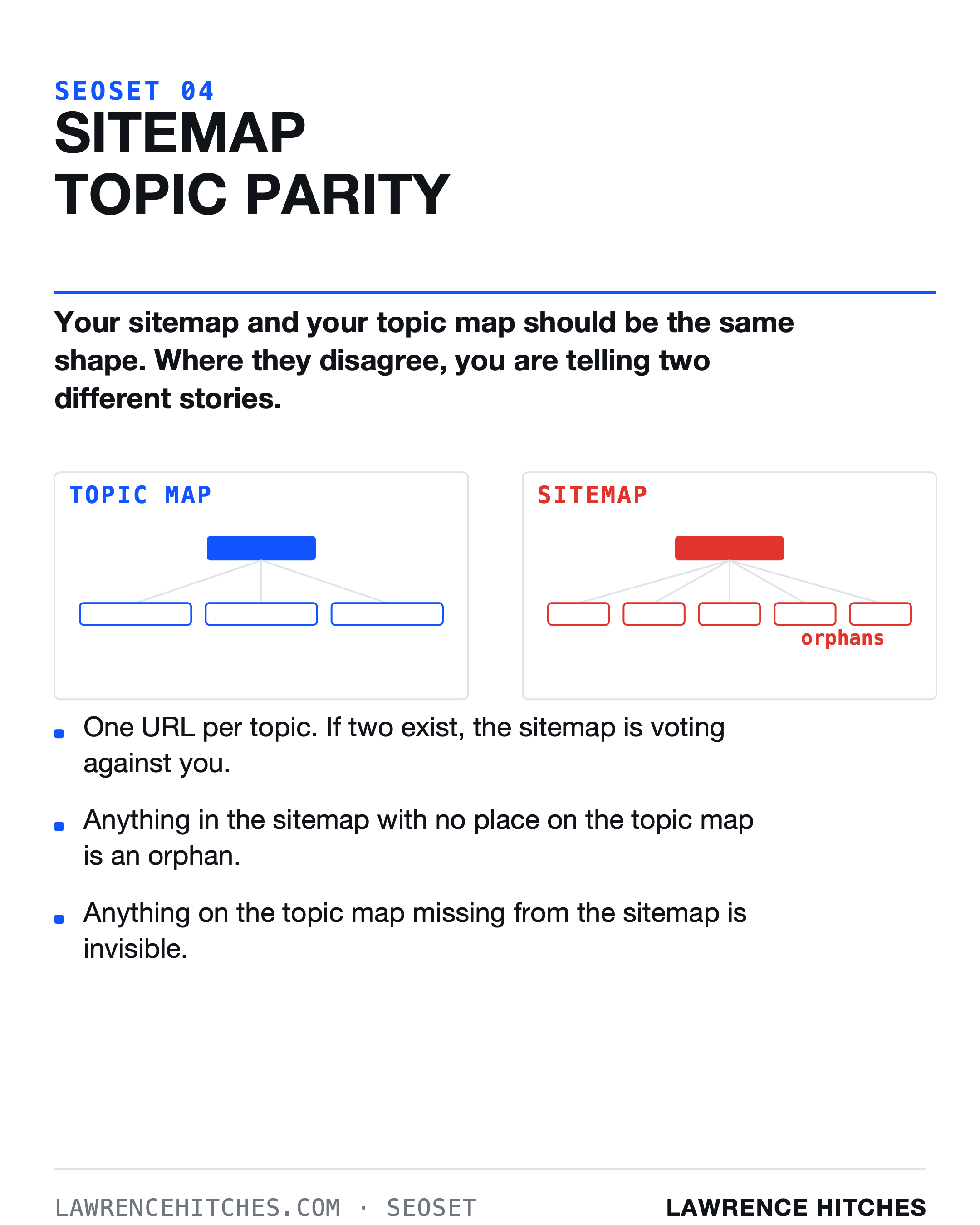
Run this on your own site Claude or ChatGPT
Compare my sitemap against my topic map. My sitemap is [URL]. My topics are [LIST], or derive them from the sitemap if I have not given them.

1. Group every URL in the sitemap under the topic it serves.
2. ORPHANS: sitemap URLs that serve no topic on the map.
3. GAPS: topics on the map with no URL in the sitemap.
4. DUPLICATES: topics with more than one URL competing, and which should be canonical.
5. Give me a table: URL, problem, action (keep, merge, redirect, noindex, write), priority.

Never recommend removing a URL that has inbound links without saying so out loud.
Run this on your own site Claude or ChatGPT
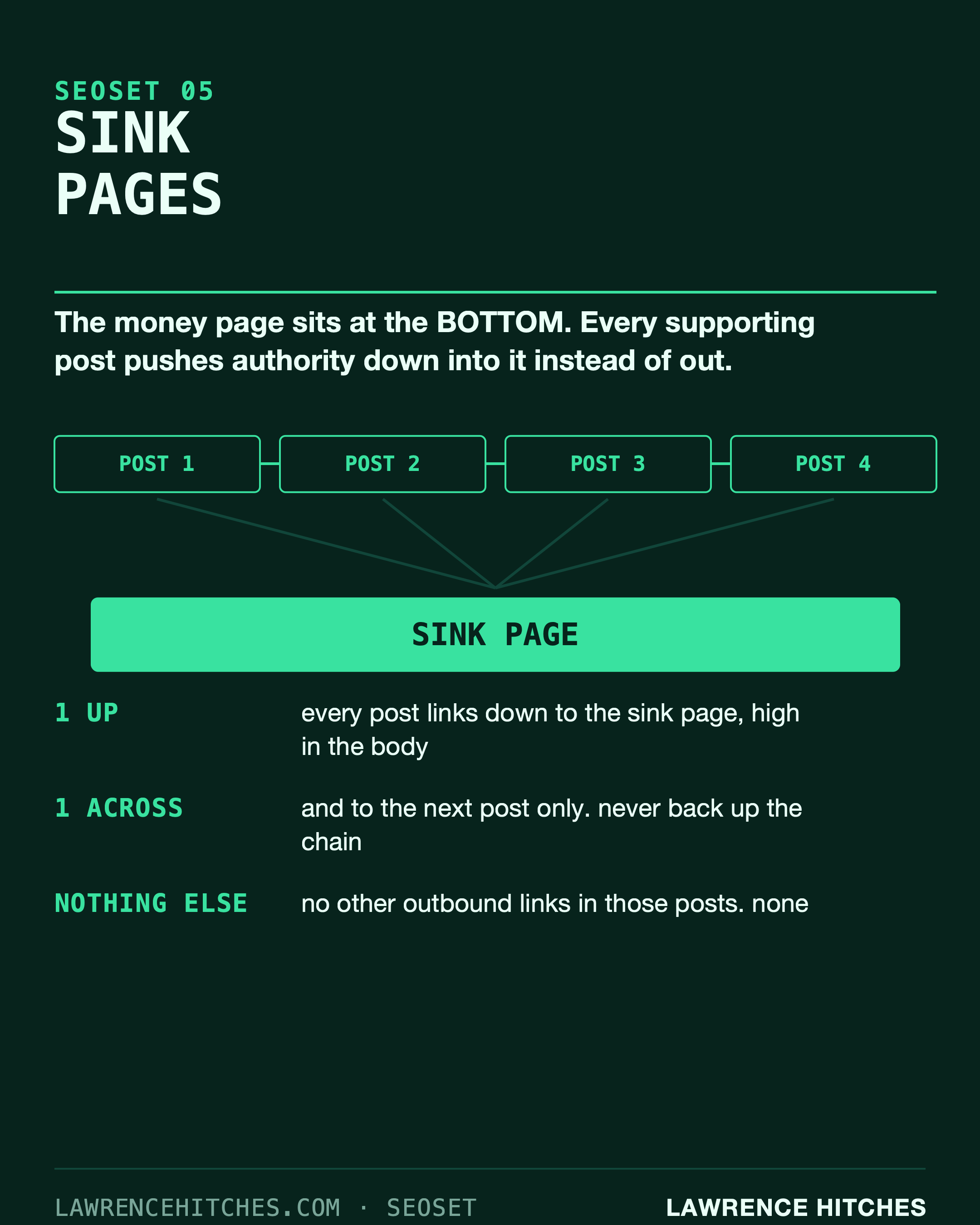
Build me a sink page cluster. My money page is [URL], it targets [KEYWORD], and it sits around position [N].

1. Give me 4 to 6 supporting article topics. Start narrow and long-tail, widen as they go. Each has to be a question a real buyer asks.
2. For each: the working title and the single most important thing it must cover.
3. Write the internal linking plan using this rule, exactly. Every supporting post links DOWN to the money page, high in the body, and ACROSS to the next post in the sequence only. Never back up the chain. No other outbound links in those posts.
4. Give me the anchor text for every link. Vary it. Do not repeat the exact keyword each time.
5. Tell me the publishing order and why that order.

For each post, list precisely which links it carries and nothing else.
Run this on your own site Claude or ChatGPT
Audit [URL] for the faults that hurt screen readers and search engines at the same time.

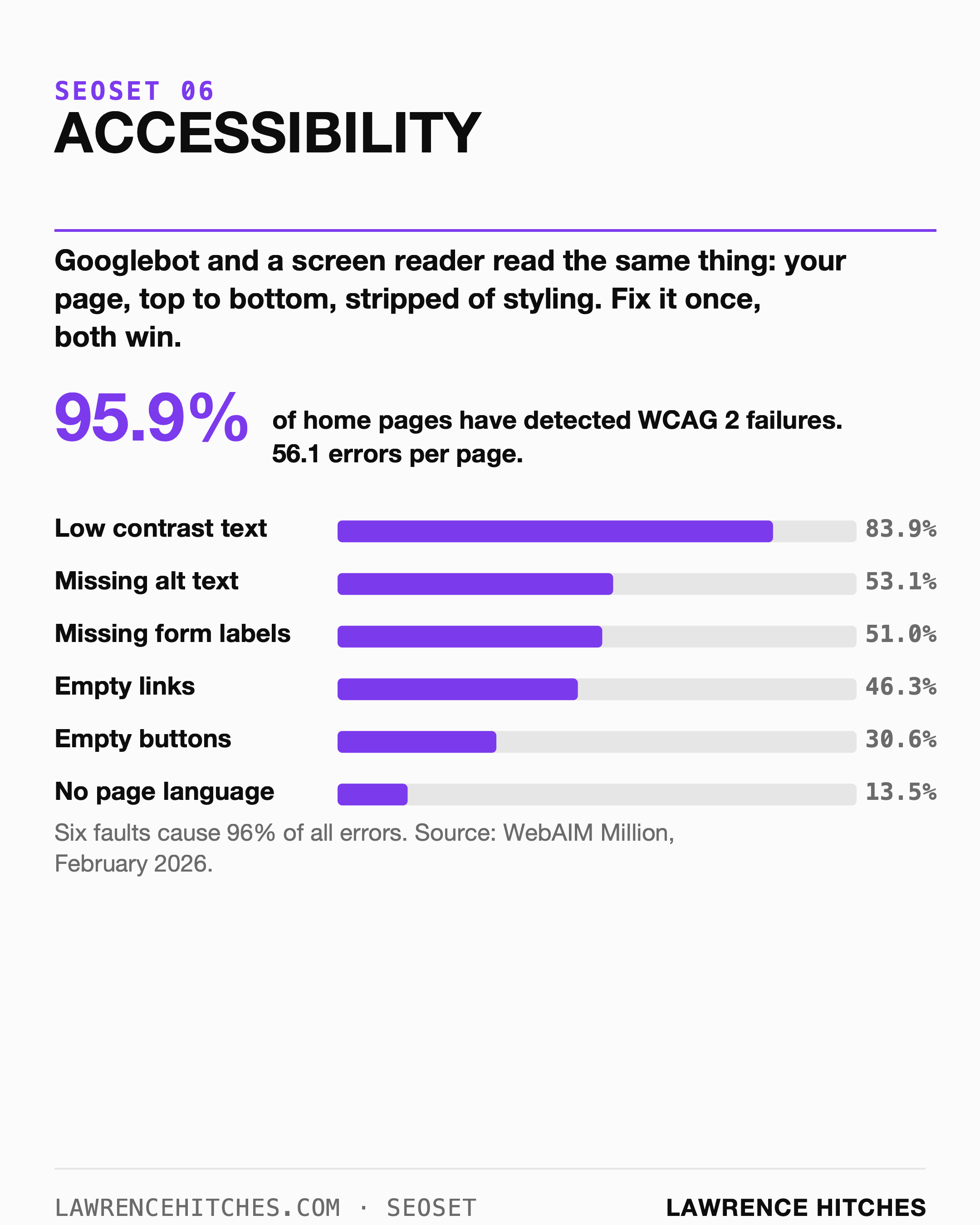
Check these six, which cause most errors on most sites:
1. Low contrast text
2. Images with no alternative text
3. Form inputs with no label
4. Links with no text
5. Buttons with no text
6. Missing page language

For each: how many instances, where they are, the exact fix, and whether it also changes how a search engine reads the page.

Then describe my page as a screen reader meets it: top to bottom, no styling, no images. If the order stops making sense read that way, tell me exactly where it breaks.
Run this on your own site Claude or ChatGPT
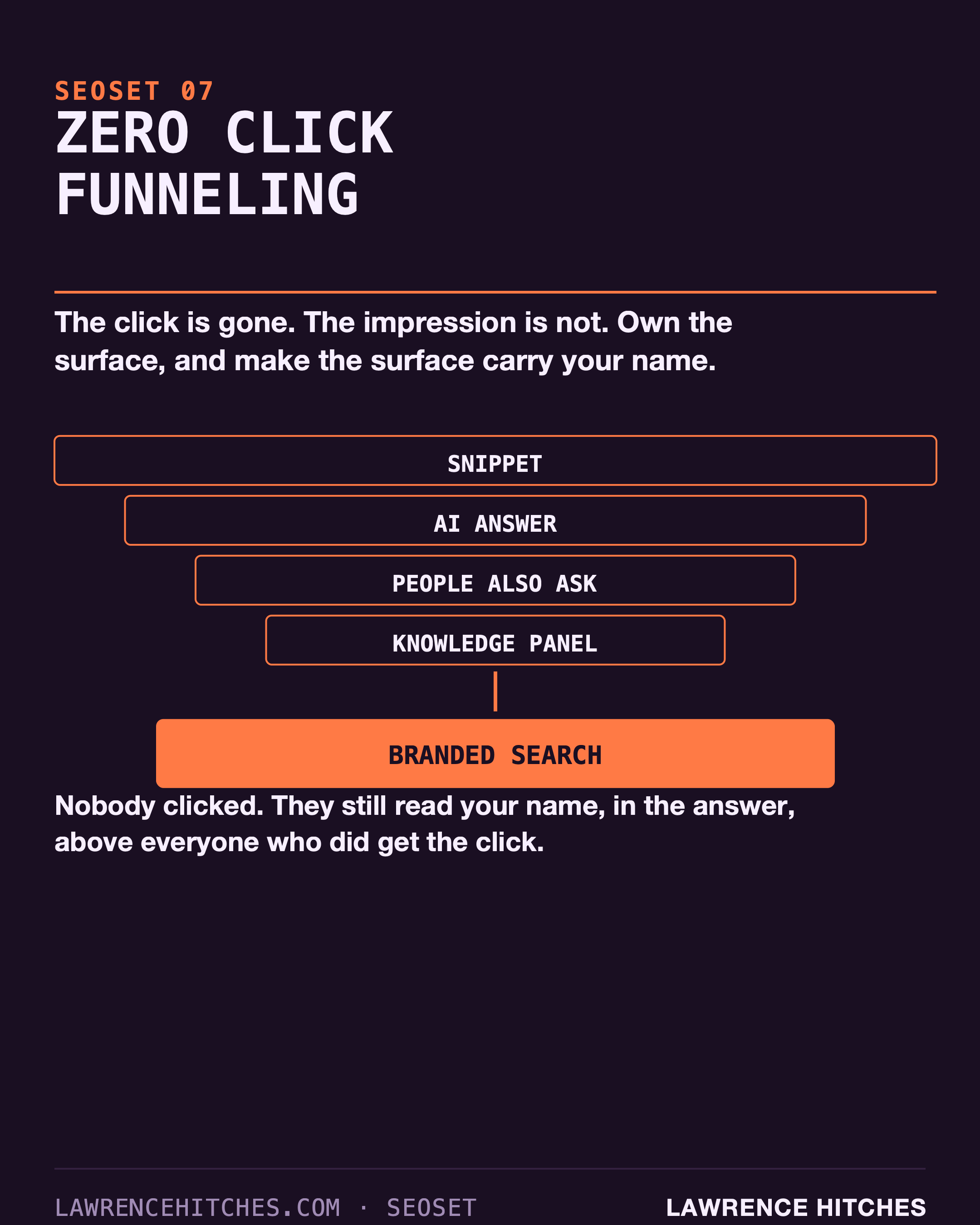
My page is [URL] and it targets [QUERY]. Assume nobody clicks. The goal is to be the answer and still be recognised.

1. Which surfaces can this query win: featured snippet, AI answer, People Also Ask, knowledge panel, or none? Say why for each.
2. For each winnable surface, what exact shape does the answer need: length, structure, list or table.
3. Rewrite my opening passage so it can be lifted whole into that surface, with my brand name inside the part that gets lifted.
4. Give me 5 questions someone asks after reading a zero-click answer, and which page of mine should answer each.
5. Tell me what to measure, given there is no click to count.
Run this on your own site Claude or ChatGPT
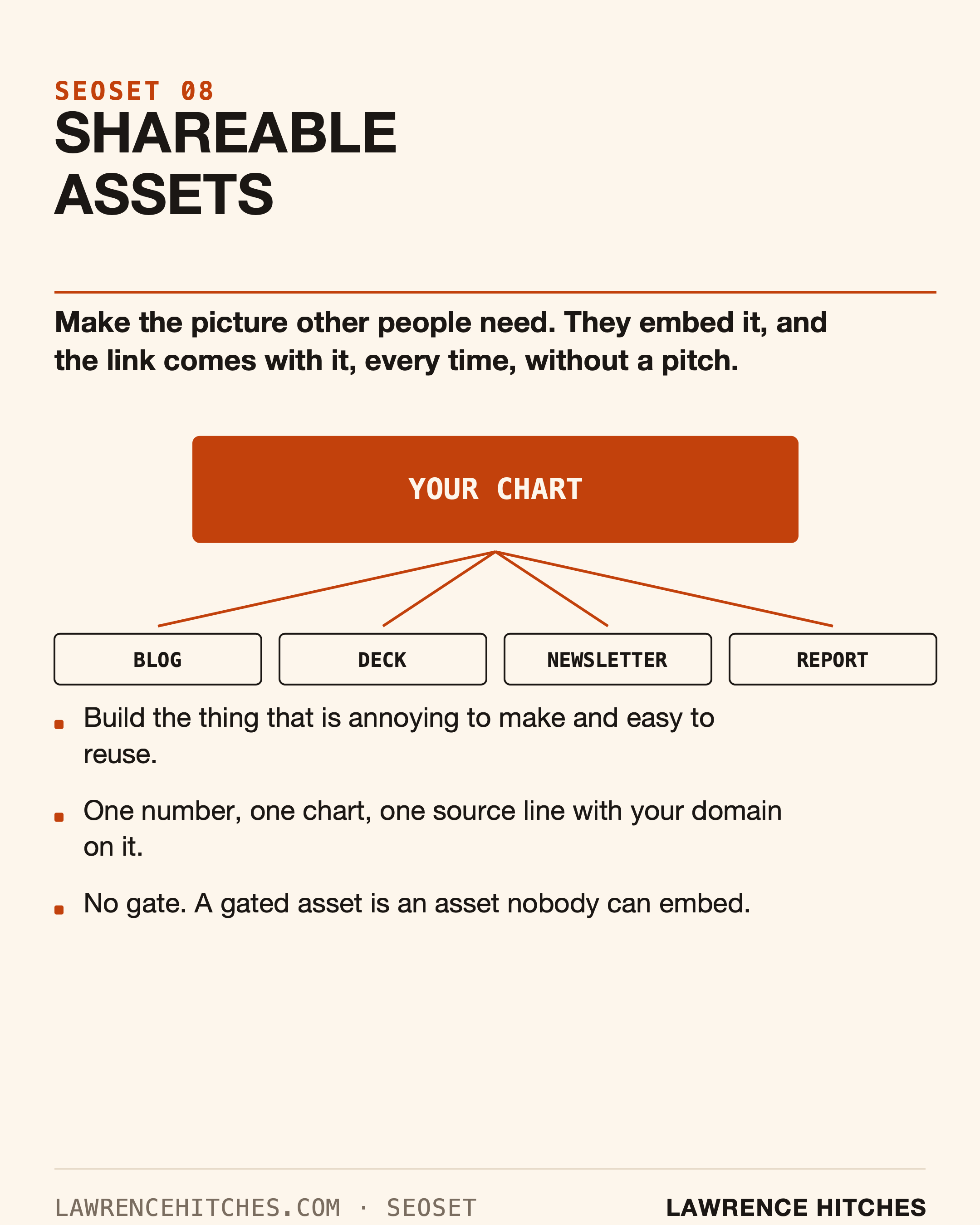
Design one asset people will embed and credit. My topic is [TOPIC]. My audience is [WHO].

1. List 5 charts, diagrams or tables about this topic that people currently rebuild themselves because no good version exists.
2. For each: what data it needs, and whether I can get that data or have to gather it.
3. Pick the one with the best ratio of annoying-to-make against easy-to-reuse, and say why.
4. Specify it: the single number or claim, the chart type, the axes, and the exact source line with my domain in it.
5. Write the embed code and the one-line caption someone pastes underneath.
6. Name 10 specific pages that would use it, with a one-sentence email to each.

No gate. An asset behind a signup is an asset nobody can embed.
More sets
Set three is being built now: technical SEO, Core Web Vitals, keyword research, search intent, and internal linking. One card each, same rule.
To get it the day it drops: follow @lawrenceaiseo and comment SEOSET on the next reel. The DM sends every set, including this page.
Want a topic on the list? Comment it under the reel. The most-requested one gets built first.
Lawrence Hitches, AI SEO Consultant, Melbourne.