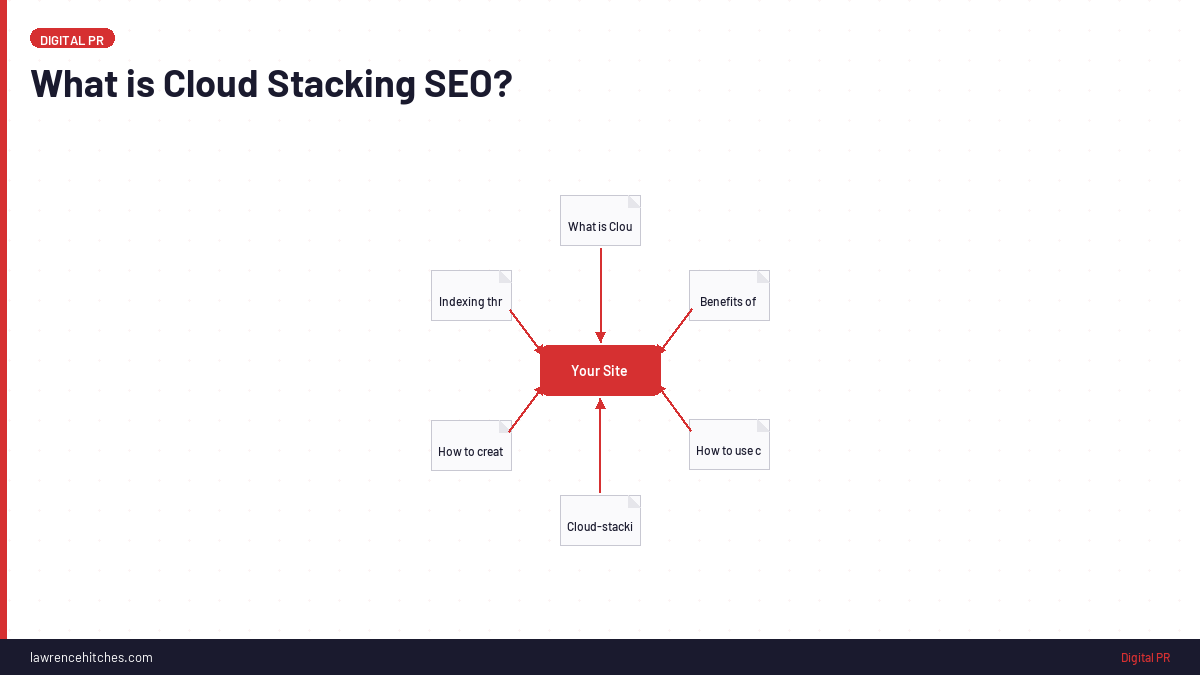
Cloud stacking SEO is the practice of hosting HTML pages on major cloud services (Amazon S3, Microsoft Azure, Google Cloud Storage) and linking them to your main website, on the theory that pages on a powerful domain like amazonaws.com inherit some of that domain's authority. The honest answer in 2026: cloud stacking is an old, overrated tactic. It is built on a misunderstanding of how domain-level signals work, the links it produces are low-value, and at scale it drifts into territory Google's spam policies target. This guide explains what cloud stacking is, why it underdelivers, and where to put the effort instead.
What Is Cloud Stacking SEO?
Cloud stacking works like this. Instead of building backlinks the usual way, you create simple HTML pages and host them on a cloud storage service. A page uploaded to Amazon S3 gets a URL on the s3.amazonaws.com domain. The promoters' pitch is that because amazonaws.com is an enormous, trusted domain, a page hosted there carries borrowed authority, and a link from that page to your site passes some of it along.
You then "stack" these: create many such pages across S3, Azure Blob Storage, and Google Cloud Storage, each linking to your main site, and supposedly build a diversified, high-authority link profile cheaply.
It sounds clever. That is most of its appeal. The mechanics do not hold up.
Why Cloud Stacking Is Overrated
Four problems, in order of how much they matter.
1. Subdomains do not inherit authority the way the pitch claims
The whole tactic rests on the idea that a page on s3.amazonaws.com is strong because amazonaws.com is strong. Search engines do not work that way. A storage bucket on S3 is treated as effectively its own isolated property. It has no inherent topical relevance to your site, no editorial endorsement, and no real standing of its own. Third-party authority metrics may show a high score for the amazonaws.com root, but that score does not flow into a random bucket you created this morning.
2. The links are editorially worthless
A backlink carries weight when it represents a genuine signal: someone chose to reference your content. A link from an HTML file you uploaded to your own storage bucket represents nothing. You made the page, you placed the link. Search engines have spent two decades getting good at discounting self-made links, and a bare HTML page on a storage domain is one of the easiest patterns to spot.
3. At scale it looks like link spam
Creating many thin pages whose main purpose is to link to one site is, structurally, a link scheme. Google's link spam policy covers exactly this. The fact that the pages sit on a reputable host does not change what they are. Cloud stacking at any real volume carries the same risk as any other manufactured link network.
4. The effort is misallocated
Even setting risk aside, the hours spent building and uploading HTML pages produce a weaker result than the same hours spent on genuine SEO. That is the quiet cost of any tactic that looks like a shortcut.
Does Cloud Stacking Still Work in 2026?
Marginally, unreliably, and not in a way worth pursuing. Some practitioners report small short-term movements, which is plausible: any new page that gets indexed and links to you can have a tiny transient effect. But a tiny, decaying effect from a tactic that risks a spam classification is a bad trade.
The tactic also ages badly. It was conceived for an older model of SEO where link volume and borrowed domain metrics mattered more. In 2026, search and AI systems weight genuine authority, topical relevance, and brand signals. Cloud stacking produces none of those.
What to Do Instead
The honest alternative is not exciting, which is exactly why it works. The same effort, redirected:
- Earn real links. Digital PR, genuinely useful linkable assets (original data, tools, research), and being quotable in your niche produce links that represent real endorsement. A handful of those beats a hundred cloud-stacked pages.
- Strengthen your own site. Internal linking, topical depth, and clean technical SEO compound. They are fully within your control and carry no risk.
- Build brand and entity signals. Mentions, consistent presence, and a recognisable identity are what modern search and AI systems actually reward. That is the durable version of "authority."
- Publish content worth citing. The most reliable way to be linked, and to be cited by AI engines, is to be the best available source on a question.
Cloud stacking is a tactic that sounds like leverage and behaves like busywork with downside. Skip it.
How Far Should You Push Google's Rules?
SEO maturity is a spectrum: too scared to test anything and you learn nothing, too far past the line and you build on borrowed time. Tactics like cloud stacking sit in that grey zone, which is exactly why understanding them beats pretending they do not exist:
Watch the reel on Instagram: The SEO maturity spectrumMore like this → Follow @lawrenceaiseo
FAQ
Is cloud stacking SEO a black-hat technique?
It sits in grey-hat territory and trends black at scale. Creating thin pages whose purpose is to link to your site falls under Google's link spam policy. A small number of pages is low-impact rather than dangerous, but the tactic has no clean version that also works well.
Can you get penalised for cloud stacking?
At volume, yes, the same way any manufactured link network can be devalued or actioned. More commonly the links are simply ignored, so you carry the risk without the reward.
Does hosting a page on Amazon S3 give it Amazon's domain authority?
No. This is the core misconception behind cloud stacking. A storage bucket is treated as an isolated property. It does not inherit the standing of the amazonaws.com root domain.
What is a better alternative to cloud stacking?
Earning genuine editorial links through digital PR and linkable assets, strengthening your own site's internal linking and topical depth, and building brand and entity signals. These are slower but durable and risk-free.
Related Reading
- Types of Links in SEO Explained
- Why Internal Links Matter for SEO
- Link Manipulation in SEO
- Digital PR and Link Building
Sources & Further Reading
Enjoying this? The 60-second versions live on Instagram.
Follow @lawrenceaiseo →Soaring Above Search
Weekly AI search insights from the front line. One newsletter. Six sections. Everything that actually moved this week, with a practitioner's take.

AI SEO consultant and AI search consultant helping brands appear in AI Overviews, AI Mode and ChatGPT. Chief of Staff at StudioHawk, Australia's largest dedicated SEO agency. Runs a measured three-channel playbook: Google, Bing and AI citations. Book a free consultation →