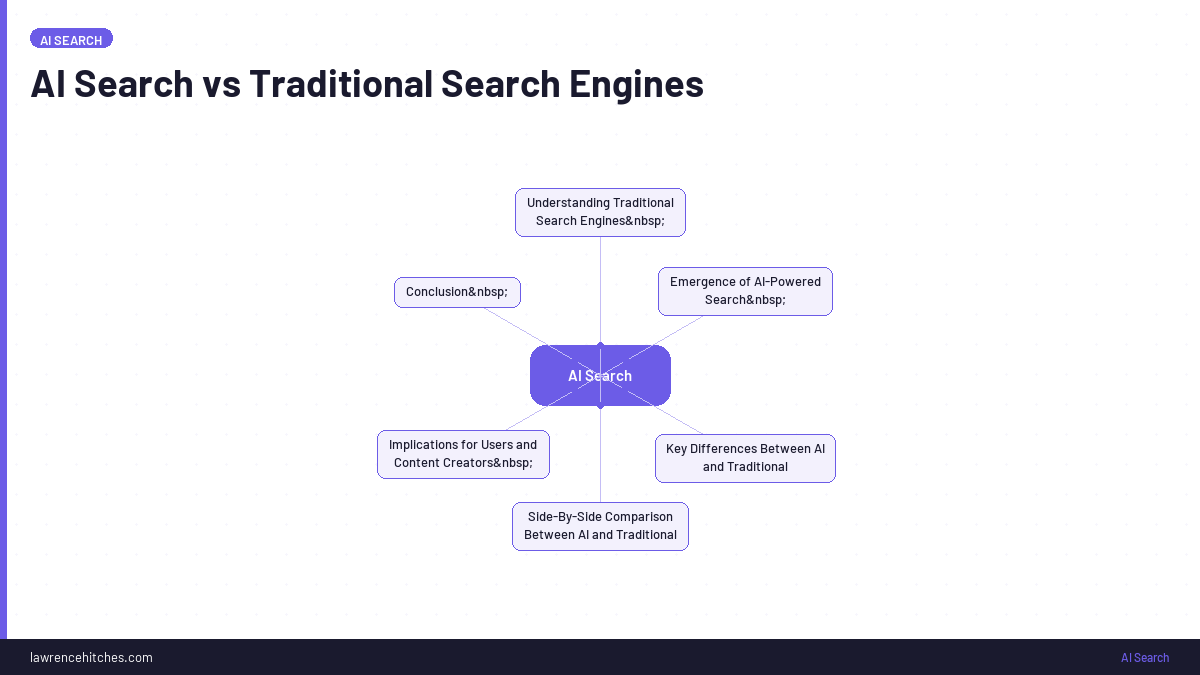
The difference between an AI search engine and a traditional search engine is what they return: a traditional engine gives a ranked list of links, an AI search engine reads multiple sources and returns one synthesised answer with citations.
The core difference: a traditional search engine returns a ranked list of links and leaves you to find the answer; an AI search engine reads multiple sources and returns a synthesised answer with citations. Traditional engines (Google's classic results, Bing) match queries to pages using keywords, links, and hundreds of ranking signals. AI search engines (ChatGPT, Perplexity, Google AI Overviews and AI Mode, Microsoft Copilot) use language models to interpret intent, retrieve relevant sources, and generate a direct response. For SEO, the practical shift is from optimising to be clicked to optimising to be cited, and in 2026 you need to do both, because they are not separate systems.
How Traditional Search Engines Work
Traditional search engines like Google's classic results and Bing follow a long-established model: crawl the web, index pages, and rank them against a query.
Two foundations have always done the heavy lifting:
- Keyword and relevance matching. The engine identifies pages whose content matches the query's meaning. Modern engines do this semantically, not just by literal word match, but the principle holds.
- Link-based authority. Descended from PageRank, the engine uses links and many other signals to judge which relevant pages are most trustworthy.
The output is a list of links. The engine's job ends at "here are the pages most likely to answer you." Finding the actual answer is the user's job.
How AI Search Engines Work
AI search engines change the output. Instead of a list, they return an answer.
The mechanism, simplified: when you ask a question, the system interprets your intent with a language model, retrieves relevant sources (often by running its own searches behind the scenes), reads those sources, and generates a synthesised response, usually with citations to the pages it drew from.
This is why AI search can answer questions no single page covers. Ask "how do I fix a caching issue on WordPress with a specific host," and a traditional engine returns the closest existing pages. An AI engine can pull the WordPress caching guidance from one source and the host-specific detail from another and merge them into one answer.
The critical point for SEO: retrieval still happens first. An AI engine cannot cite a page it never retrieved, and retrieval leans heavily on the same ranking systems traditional search uses. AI search did not replace SEO. It added a citation layer on top of it.
The Key Differences
| Aspect | Traditional Search | AI Search |
|---|---|---|
| Output | A ranked list of links | A synthesised answer with citations |
| Interaction | One query at a time, each independent | Conversational, understands follow-ups |
| Intent handling | Strong, semantic, but query-bound | Interprets intent and reasons across sources |
| Source use | Sends you to one page | Merges several sources into one response |
| The SEO goal | Rank high enough to be clicked | Be retrieved and cited as a source |
What This Changed for SEO
Less than the hype suggests, and more than the sceptics admit.
What did not change: the fundamentals. AI engines retrieve from indexes built by ranking systems. A page that is crawlable, authoritative, relevant, and technically sound is what gets retrieved and therefore what is eligible to be cited. Strong SEO is the entry ticket.
What did change: the emphasis. Three things matter more now than they did:
- Answer-first structure. AI engines extract self-contained passages. Content that states a clear answer in the first paragraph of a section is far more extractable than content that buries it.
- Factual specificity. Concrete claims, named sources, and real numbers get quoted. Vague writing does not.
- Entity clarity and brand presence. AI systems reason about entities. They cite sources they can confidently associate with a topic.
Google's own guidance is blunt about this: optimising for generative AI search is, in its words, still SEO. You are not running two strategies. You are running one, sharpened.
How to Optimise for Both at Once
One content approach serves the blue links and the AI answers:
- Stay technically retrievable. Crawlable, indexable, fast. If a page cannot be retrieved, it cannot rank or be cited.
- Lead every section with the answer. A 40 to 150 word self-contained answer at the top of each section serves the human scanner and the AI extractor equally.
- Be specific and sourced. Real numbers, named references, working links. This earns both traditional ranking and AI citation.
- Build authority and entity clarity. Topical depth, consistent identity, genuine external signals. This is what makes you a source worth retrieving.
Related concepts
This difference plays out across specific engines. See Google vs Bing for the incumbent split, and how AI is changing SEO for what it means for your visibility.
FAQ
Will AI search replace traditional search engines?
Not entirely, and not soon. AI search and traditional results increasingly coexist in the same interface, Google AI Overviews sit above classic links on the same page. The two are converging, not replacing each other.
Do I need a separate SEO strategy for AI search?
No. AI engines retrieve from the same indexes traditional ranking builds. One strong content and technical strategy serves both. The only adjustment is emphasising answer-first structure and factual specificity.
How is AI search different for the user?
Traditional search hands the user a list of pages to evaluate. AI search hands them a direct, synthesised answer with citations, often conversational and able to handle follow-up questions in context.
Does ranking on Google still matter if AI answers the query?
Yes. Ranking well is how you get retrieved by AI engines in the first place. It also still earns clicks, since classic results appear alongside AI answers and many users still click through.
Related Reading
- What is Generative Engine Optimization (GEO)?
- AI Citation Mechanics
- AI Search Ranking Factors
- How Search Engines Work
Sources & Further Reading
Enjoying this? The 60-second versions live on Instagram.
Follow @lawrenceaiseo →Watch: What is AI Search? (The New SEO in 2026)
Soaring Above Search
Weekly AI search insights from the front line. One newsletter. Six sections. Everything that actually moved this week, with a practitioner's take.
AI SEO consultant and AI search consultant helping brands appear in AI Overviews, AI Mode and ChatGPT. Chief of Staff at StudioHawk, Australia's largest dedicated SEO agency. Runs a measured three-channel playbook: Google, Bing and AI citations. Book a free consultation →