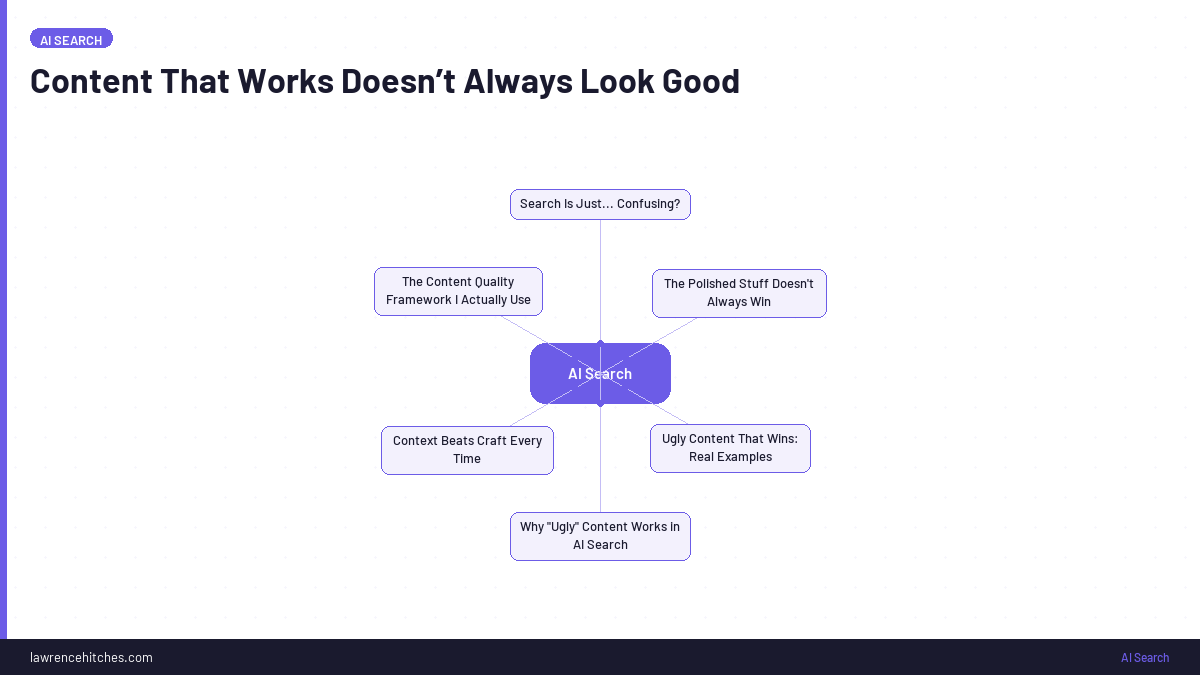
Content quality in AI search means something different from what it used to. The old formula, clean writing, proper structure, topical coverage, still matters. But AI engines add a layer underneath: they retrieve content in chunks, and every chunk competes to answer a query independently. A page can look polished and still get ignored. A rougher page with specific, sourced, first-hand content can get cited consistently. Here is what actually makes content "high quality" for AI retrieval.
Make it high quality.
I have heard that phrase in every kickoff meeting I have ever been in.
It is become this vague, comforting instruction that no one can argue with. Ask ten marketers what "high quality" actually means and you will get ten different answers, most of them recycled from 2015.
When I started in SEO, quality was measurable. Clear writing, tidy formatting, authority links, no typos. If it looked right, it was right.
That formula worked, until AI search arrived and changed the scoring criteria.
What "quality" meant before AI search
Traditional content quality came down to signals Google could measure: grammar, structure, topical coverage, backlinks from authoritative sources, low bounce rate. The assumption was that if the content looked professional and covered a topic thoroughly, it was probably good.
This worked because Google ranked pages holistically. A well-structured, well-linked page about a topic tended to rank above a thin, poorly formatted one. Quality was a page-level judgement.
The playbook: write comprehensively, format cleanly, earn links, update regularly. If your content checked all those boxes, it ranked.
What changed when AI search arrived
AI search engines, ChatGPT, Perplexity, Google AI Overviews, Gemini, do not read pages the way humans do. They retrieve content in chunks.
A chunk is roughly 400 words, or about 512 tokens. When an AI system is deciding what to cite in response to a query, it is not evaluating your page as a whole. It is evaluating individual chunks from thousands of pages simultaneously, ranking them for relevance, then tracing back to the source page to decide whether to cite it.
This matters because it means a high-quality page with low-quality chunks will not get cited consistently. The chunk is the unit of competition, not the page.
The pages that get cited most consistently are not always the most comprehensive or the best-written. They are the ones with chunks that can answer a specific question completely, in isolation, with evidence.
The five signals AI engines use to evaluate content quality
Across my work analysing AI citation patterns and client content, five signals consistently separate cited content from ignored content.
1. Specificity beats generality
"Load times matter for conversions" does not get cited. "A one-second delay in page load time reduces conversions by 7% (Akamai)" gets cited. The claim is the same. The specificity is different.
AI engines are pattern-matching for precision. A specific number, a named tool, a concrete outcome, these signal that the content has actual knowledge, not just topical awareness. When two chunks are competing to answer the same query, the more specific one tends to win.
2. Sourced claims beat assertions
An identical claim, one sourced and one unsourced, will perform differently in AI retrieval. A sourced claim reads as verifiable. An unsourced one reads as opinion.
This does not mean footnoting every sentence. It means that for any factual claim your article makes, particularly numbers, statistics, or cause-and-effect statements, you should either cite a source or anchor it to your own first-hand experience.
3. First-hand proof beats synthesis
We publish a lot of content at my agency. Some of the best-performing pieces in AI citations are not the most polished. They are the most honest: we tried this, here is what happened.
AI search systems increasingly weight first-hand experience over aggregated advice. A piece that says "I worked with a 200,000-SKU ecommerce client and their JavaScript-rendered category pages were invisible to Googlebot until we implemented server-side rendering" is more citable than "some sites have JavaScript rendering issues." Same topic. Different proof level.
4. Answer-ready structure beats explanatory structure
Traditional long-form content builds to the answer: context, explanation, caveat, conclusion, answer. AI retrieval rewards the opposite: answer first, context second.
If someone asks "what is LCP in Core Web Vitals?", a chunk that leads with "LCP (Largest Contentful Paint) measures how long it takes for the largest visible element on the page to load. Good LCP is under 2.5 seconds." is more citable than a paragraph that spends three sentences on context before defining the term.
Write the answer in the first sentence of every section, not the last.
5. Entity clarity beats ambiguity
AI engines use entity graphs to understand what content is about. Content that names specific entities, tools, companies, people, metrics, is easier to retrieve and classify than content that stays abstract.
"Improve your site's performance" is entity-poor. "Fix LCP on a Shopify store by preloading the hero image" is entity-rich. The second is retrievable for a dozen specific queries. The first is retrievable for almost none.
Quality is now chunk-level, not just page-level
This is the part most content teams miss. You can have a high-quality page, good writing, proper structure, strong E-E-A-T signals, but if your individual sections do not hold up as standalone answers, AI will not cite you consistently.
Test this yourself: take any 400-word section of your content and ask, if this was the only thing someone read, would it answer a specific question clearly? Would it make sense without the surrounding context? Does it contain at least one specific, verifiable claim?
If the answer to any of those is no, that chunk is getting skipped.
The fix is not to rewrite entire articles. It is to audit your sections for extractability. Each H2 or H3 section should be able to stand alone as a discrete answer. The heading names the question. The first paragraph answers it directly. Everything after that is supporting evidence.
The practical content quality checklist for AI search
When I review content for AI search performance, I run each major section through these checks:
- Does it lead with the answer? First sentence equals direct answer, not setup.
- Is at least one claim specific and verifiable? A number, named entity, or personal observation with context.
- Is the entity clear? A reader (or AI) should know what this section covers from the heading alone.
- Can it stand alone? Remove the surrounding paragraphs. Does it still make sense?
- Is there first-hand proof? "We saw X" beats "experts say X."
Polish is a bonus. These five are the minimum for AI retrievability.
Does this mean writing for AI instead of people?
Google's own May 2026 AI optimisation guide is direct on this: optimising for people who use AI search is still just good SEO. The signals that make content citable by AI, specificity, sourcing, answer-first structure, entity clarity, are also the signals that make content rank better in traditional search.
There is no separate AI content track. What changes is the unit of evaluation: chunk-level quality matters now in addition to page-level quality. Write for people. Structure for extractability. The rest follows.
FAQ
What counts as high-quality content in AI search?
In AI search, quality is evaluated at the chunk level, roughly 300 to 500 words per section. A high-quality chunk answers a specific query directly in the first sentence, contains at least one specific and verifiable claim, names relevant entities clearly, and can stand alone without surrounding context. Polish and readability still matter, but extractability is the new baseline.
Why does polished content sometimes get ignored by AI search engines?
AI engines do not read pages holistically, they retrieve discrete content chunks. Polished content that builds to its answer slowly, uses vague language, or lacks specific sourced claims will be skipped in favour of more specific content, even if the writing quality is lower. The scoring criteria changed: AI prioritises answer-readiness over craft.
Does longer content perform better in AI search?
Not automatically. Longer content wins if it contains more high-quality chunks, more specific sections, more sourced claims, more first-hand evidence. A 3,000-word page of padded generalities will underperform a 1,000-word page of specific, well-structured answers. Depth matters, not length.
Do I need to write specifically for AI search?
No. Google's May 2026 AI optimisation guide states that optimising for generative AI search is still standard SEO. The signals that make content citable by AI (specificity, sourcing, answer-first structure) are the same signals that improve traditional rankings. Write for people; structure for extractability.
How do I know if my content is being cited by AI search?
Track AI referral traffic in GA4 using regex filters across known AI sources (chatgpt.com, perplexity.ai, claude.ai, gemini.google.com). Check branded search volumes for uplift, AI citations drive brand queries even when they do not send direct referral clicks. For direct monitoring, run target queries through ChatGPT, Perplexity and Gemini manually and log which sources get cited.
Sources and further reading
- Google AI Optimisation Guide (May 2026)
- AI Citation Mechanics: How AI Engines Retrieve and Cite Content
- What is Generative Engine Optimisation (GEO)?
- Technical SEO for AI Search
Hawk Academy Skill
Information Gain Finder
Scans your content to identify what is repetitive or commodity, then surfaces unique angles only you can credibly cover.
Sources & Further Reading
Enjoying this? The 60-second versions live on Instagram.
Follow @lawrenceaiseo →Soaring Above Search
Weekly AI search insights from the front line. One newsletter. Six sections. Everything that actually moved this week, with a practitioner's take.
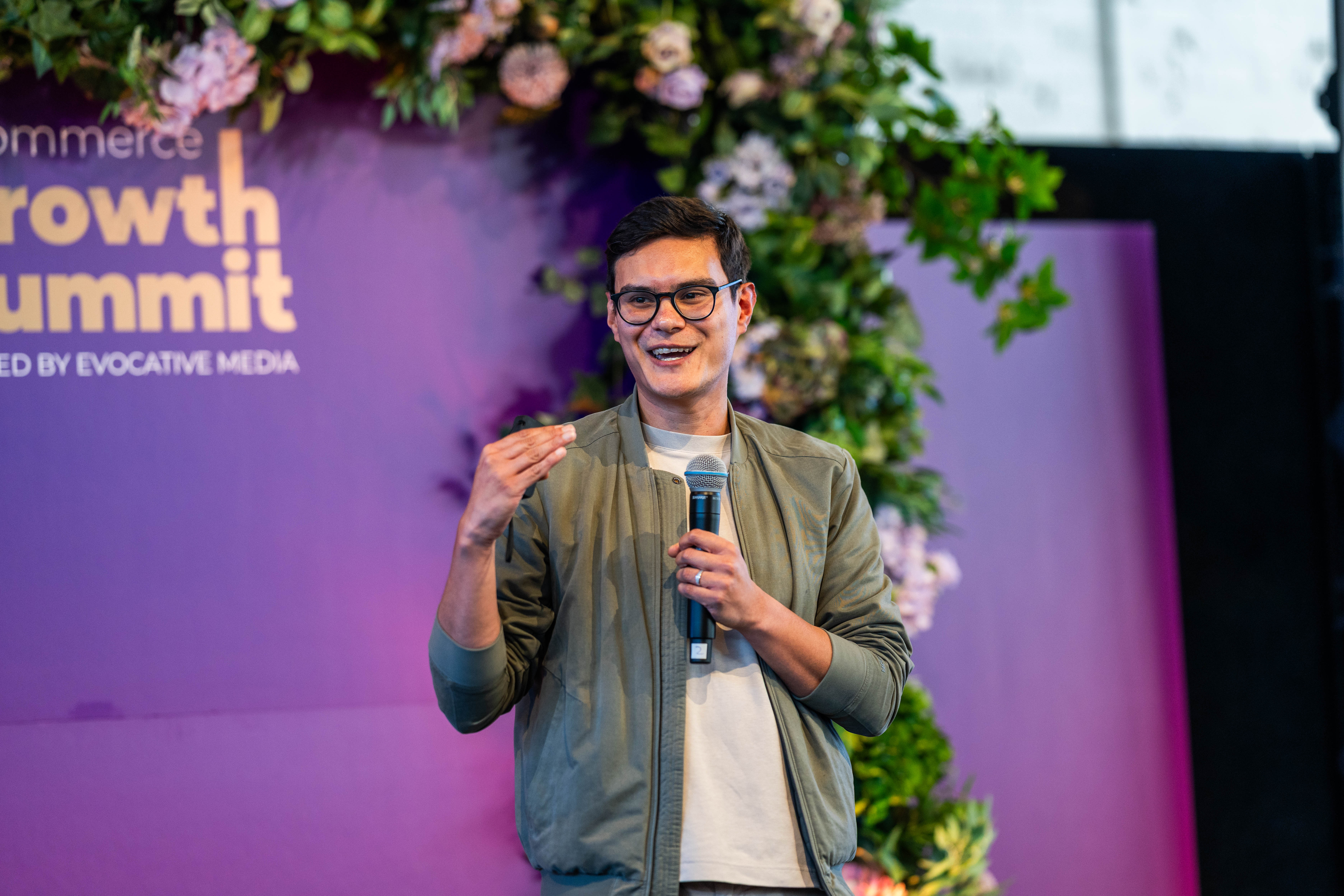
AI SEO consultant and AI search consultant helping brands appear in AI Overviews, AI Mode and ChatGPT. Chief of Staff at StudioHawk, Australia's largest dedicated SEO agency. Runs a measured three-channel playbook: Google, Bing and AI citations. Book a free consultation →