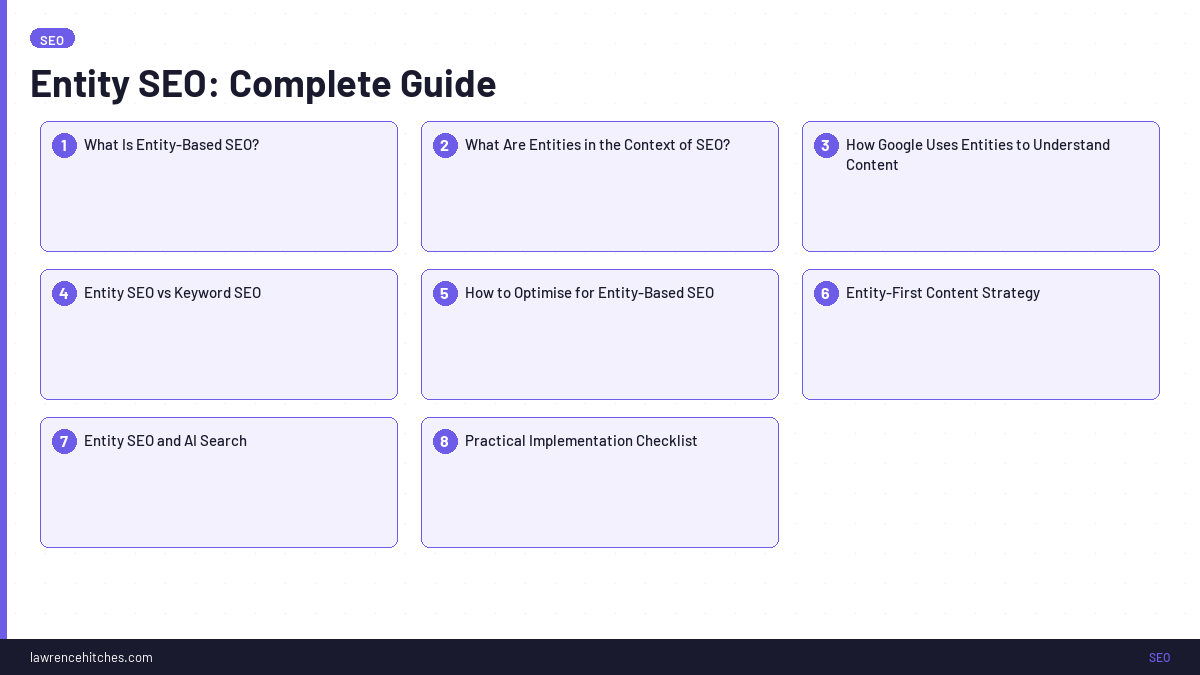
Entity SEO is the practice of optimising content around entities, distinct, identifiable things such as people, places, brands, products, and concepts, rather than around keyword strings. Search engines moved from matching words to understanding things when Google launched the Knowledge Graph in 2012 under the banner "things, not strings." In 2026, entity clarity matters more than ever, because AI search engines rely on entity recognition to decide which sources are authoritative and citable on a topic. This guide covers what an entity is, how entity SEO works, and how to build entity clarity into your site.
What Is an Entity?
An entity is a uniquely identifiable thing, defined by four properties: a name, a type, attributes, and relationships to other entities.
Take the Eiffel Tower. Its name is "Eiffel Tower." Its type is "monument." Its attributes include its height, location, and construction date. Its relationships connect it to Paris, to Gustave Eiffel, and to France. A search engine that understands all four of those things understands the Eiffel Tower as a thing, not as a sequence of letters.
Entities are not only physical objects. A person, a company, a product, an event, and an abstract concept like "topical authority" are all entities. What makes something an entity is that it can be distinctly identified and described.
Entities gain formal recognition when they are catalogued in a knowledge base such as Wikipedia, Wikidata, DBpedia, or Google's own Knowledge Graph, each of which assigns the entity a unique identifier. That identifier is how a search engine knows your "Apple" the company is not "apple" the fruit.
Why Entities Replaced Keyword Matching
Early search engines matched the literal words in a query against the literal words on a page. That approach had a hard ceiling. It could not tell that "how much does a Tesla cost" and "Tesla price" mean the same thing, and it could not tell which "Jaguar" a searcher meant.
Google's 2012 Knowledge Graph announcement, titled "Things, not strings," marked the shift. The search engine began building a model of real-world things and their relationships. Hummingbird, RankBrain, BERT, and the language models behind modern search each pushed that further. Today, search interprets meaning and intent, not character strings.
The practical consequence: you no longer rank by repeating a keyword. You rank by demonstrating, clearly and consistently, that your page is about a specific entity and the cluster of related entities around it.
Entity SEO in AI Search
Entity SEO matters more in 2026 than it did when the Knowledge Graph launched, because AI search engines are entity engines at their core.
When ChatGPT, Perplexity, Google AI Overviews, or Claude answer a question, they are reasoning about entities and their relationships. To cite your page as a source on a topic, an AI system needs to be confident that your page, and ideally your brand, is a recognised entity associated with that topic. Entity ambiguity, where a search engine is not sure what or who you are, is one of the quietest reasons good content fails to get cited.
Strong entity signals do three things in AI search:
- They disambiguate you. A clear entity profile tells AI systems exactly which person, brand, or concept your content represents.
- They establish topical association. Consistent association between your entity and a topic builds the confidence an AI engine needs to cite you on that topic.
- They support cross-source verification. AI systems triangulate. An entity confirmed across your site, your schema, and third-party sources is far more citable than one that exists only on your own pages.
How to Do Entity SEO
Entity SEO is less about individual pages and more about consistency across your whole site. The core moves:
1. Define your core entities
Decide what your site is about at the entity level. For a consultant, the core entities are the person, their service, and the handful of topics they own. For a business, it is the brand, the products, and the categories. Everything else supports these.
2. Build an entity home for each one
Every important entity needs a single, canonical page that defines it: an About page for a person, a service page for a service, a pillar page for a topic. That page is the entity's home, and everything else links to it.
3. Use schema to declare entities explicitly
Schema.org markup (Person, Organization, Product, and the @id property that links them into an entity graph) tells search engines, in machine-readable form, what your entities are and how they relate. Note that Google has stated schema is not required for AI search specifically. It remains valuable here because it removes ambiguity about your entities for every engine that reads it, and it costs little to implement.
4. Strengthen relationships with internal linking
Internal links are how you express entity relationships on your own site. Linking your topic pages to your service page, and your supporting articles to your pillars, builds a connected entity model search engines can follow.
5. Earn external entity confirmation
An entity that only exists on your own site is weakly established. Mentions, citations, profiles, and links from other reputable sources confirm the entity exists in the wider web, which is what moves you from "claimed" to "recognised."
6. Be consistent everywhere
Use the same name, the same description, and the same core facts about each entity across your site and your off-site profiles. Inconsistency creates the ambiguity entity SEO exists to remove.
Entity SEO vs Semantic SEO vs Topical Authority
These three terms overlap and are often used loosely. The distinction:
- Entity SEO is about clarity, making sure search engines know exactly what things your content is about.
- Semantic SEO is about meaning, covering a topic with the depth and related-concept coverage that signals genuine understanding.
- Topical authority is the outcome, the recognised standing you earn on a topic when entity clarity and semantic depth compound over time.
They are not competing strategies. Entity clarity and semantic depth are the inputs; topical authority is what they produce.
FAQ
What is the difference between entity SEO and keyword SEO?
Keyword SEO optimises for specific search terms. Entity SEO optimises for the things those terms refer to, the people, brands, products, and concepts, so search engines understand your content regardless of the exact words a searcher uses.
Do I need schema markup for entity SEO?
It helps but is not strictly required. Schema is the clearest way to declare entities to search engines, and Google still recommends it for traditional rich results. Google has stated it is not required for AI search specifically. Given how cheap it is to implement, it is still worth doing for entity clarity.
How do entities affect AI search?
AI search engines reason about entities and their relationships to construct answers. To cite your content, an AI system needs confidence that your page and brand are recognised entities associated with the topic. Strong, consistent entity signals directly improve citation likelihood.
How do I get my brand recognised as an entity?
Define the entity clearly on a canonical page, declare it with schema, keep its name and description consistent everywhere, and earn confirmation from third-party sources. Recognition comes from consistency plus external corroboration.
What is the Knowledge Graph?
Google's Knowledge Graph is a database of entities and their relationships, launched in 2012. It is what lets Google understand "things, not strings," and it powers Knowledge Panels and much of how Google disambiguates entities.
Related Reading
- What Is Semantic SEO?
- What Is Topical Authority in SEO?
- Structured Data for AI Search Engines
- AI Citation Mechanics
Sources & Further Reading
Enjoying this? The 60-second versions live on Instagram.
Follow @lawrenceaiseo →Soaring Above Search
Weekly AI search insights from the front line. One newsletter. Six sections. Everything that actually moved this week, with a practitioner's take.

AI SEO consultant and AI search consultant helping brands appear in AI Overviews, AI Mode and ChatGPT. Chief of Staff at StudioHawk, Australia's largest dedicated SEO agency. Runs a measured three-channel playbook: Google, Bing and AI citations. Book a free consultation →