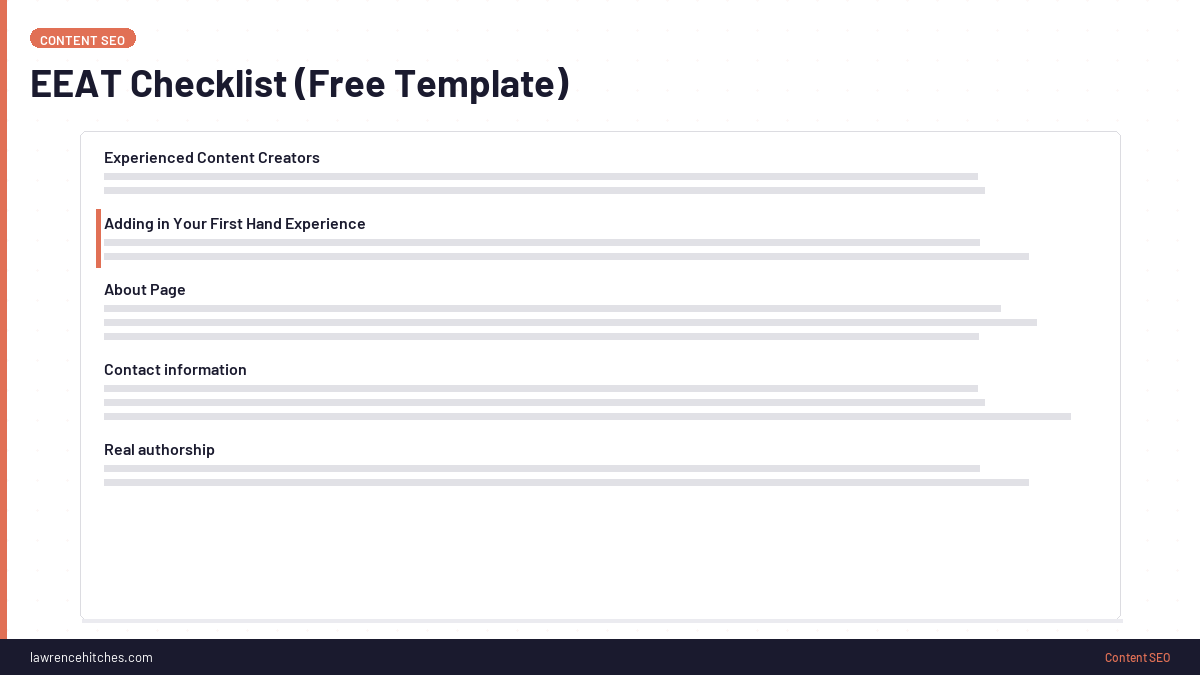
E-E-A-T stands for Experience, Expertise, Authoritativeness, and Trustworthiness. It is the framework Google's Search Quality Rater Guidelines use to assess content quality, and in 2026 AI search engines use the same signals to decide which sources to cite. This checklist works through all four pillars with the concrete things to audit on your site: first-hand experience markers, a real About page, clear authorship, topical depth, trust pages, and technical health. A free downloadable template is linked below.
Download the checklist: E-E-A-T Checklist Template (File, then Make a copy, to save your own version).
What E-E-A-T Is, Briefly
E-E-A-T is not a ranking factor you can switch on. It is a lens. Google's human quality raters use it to score whether a page is genuinely helpful and trustworthy, and that scoring feeds back into how Google trains and tunes its ranking systems. The extra "E", Experience, was added in late 2022, recognising that first-hand experience often matters as much as formal expertise.
The 2026 reason to care more, not less: AI search engines lean on the same trust signals. When ChatGPT, Perplexity, or Google AI Overviews choose which sources to cite, they favour content that demonstrably comes from someone with experience, expertise, and a credible identity. Weak E-E-A-T now costs you twice, in ranking and in citation.
Experience: Show You Have Done the Thing
Experience is the easiest pillar to fake and the easiest to verify. Auditors and AI systems both look for proof the content comes from someone who has actually done what they are writing about.
- Add first-hand examples and case studies from work you have genuinely done. Specifics that only a practitioner would know.
- Include original screenshots, photos, or data rather than stock or generic visuals. Proof you were there.
- Use video where it fits. Showing your face and voice is a strong, hard-to-fake experience signal.
- Bring in expert commentary where your own experience is thin, with a named, credible source.
Expertise: Make the Author and Site Credible
Expertise is about demonstrating the person and organisation behind the content are qualified to produce it.
- Build a detailed About page for the person or company, covering who you are and why you are qualified on this topic.
- Create author bio pages with real credentials, background, and a photo. Raters and AI systems both check authorship.
- Add Person and Organization schema so the author and brand are declared in machine-readable form. Note Google has said schema is not required for AI search specifically, but it remains a cheap, clear way to state who you are.
- Connect the author bio to the About page so the credentials chain is consistent.
Authoritativeness: Become the Go-To Source
Authoritativeness is reputation. It is earned by being recognised, on and off your site, as a leading source on a topic.
- Build topical authority: cover your subject in genuine depth, not one page but a connected cluster answering the full range of questions a reader has.
- Earn external recognition: mentions, citations, and links from other reputable sources in your field.
- Keep your entity consistent: the same name, role, and description across your site and your off-site profiles.
- Internally link your supporting content to your pillar pages so the authority is structurally visible.
Trustworthiness: Remove Every Reason to Doubt You
Trust is the pillar Google weights most heavily, and the one most sites neglect. It is largely about removing friction and red flags.
- Publish clear contact information: a real way to reach you, and for a local business, an address and phone consistent with your Google Business Profile.
- Add the trust pages: privacy policy, terms and conditions, and a refund policy if you sell anything. Their absence is a visible red flag.
- Fix technical health: resolve Search Console errors, run HTTPS site-wide, keep the site fast and mobile-sound.
- Maintain accurate, current information. Stale dates, dead links, and outdated facts all erode trust.
- Keep active, linked social profiles so a brand search returns a consistent, legitimate footprint.
E-E-A-T in AI Search
The same checklist now does double duty. AI search engines cannot directly read a quality rater's mind, but they infer trust from the same observable signals: a real author with credentials, a credible organisation, topical depth, external corroboration, and a clean, current site.
The practical implication: do not treat E-E-A-T as a Google-only exercise. Every item on this checklist is also a reason an AI engine will or will not treat you as a citable source. Strong E-E-A-T is now the shared foundation under both ranking and citation.
FAQ
What does E-E-A-T stand for?
Experience, Expertise, Authoritativeness, and Trustworthiness. It is the framework in Google's Search Quality Rater Guidelines used to assess content quality. The first "E", Experience, was added in December 2022.
Is E-E-A-T a ranking factor?
Not a direct one. E-E-A-T is a concept human quality raters use to evaluate content, and their assessments inform how Google trains its ranking systems. You cannot optimise an "E-E-A-T score" directly; you improve the underlying signals.
Which E-E-A-T pillar matters most?
Trust. Google's guidelines describe Trust as the most important member of the family, the others support it. A page can show expertise and still fail if it is untrustworthy.
Does E-E-A-T affect AI search?
Yes. AI search engines use the same observable trust signals, real authorship, credentials, topical depth, external corroboration, to decide which sources to cite. Strong E-E-A-T improves both ranking and AI citation.
How do I demonstrate experience for E-E-A-T?
Use first-hand examples, original screenshots and data, and video where it fits. The goal is verifiable proof the content comes from someone who has actually done the thing, not summarised others who have.
Related Reading
- What is E-E-A-T? The Complete Guide
- What Is Topical Authority in SEO?
- Entity SEO: The Complete Guide
- How to Do an SEO Audit
Sources & Further Reading
Enjoying this? The 60-second versions live on Instagram.
Follow @lawrenceaiseo →Watch: Google EEAT in 2025: How to Get It Right
Soaring Above Search
Weekly AI search insights from the front line. One newsletter. Six sections. Everything that actually moved this week, with a practitioner's take.
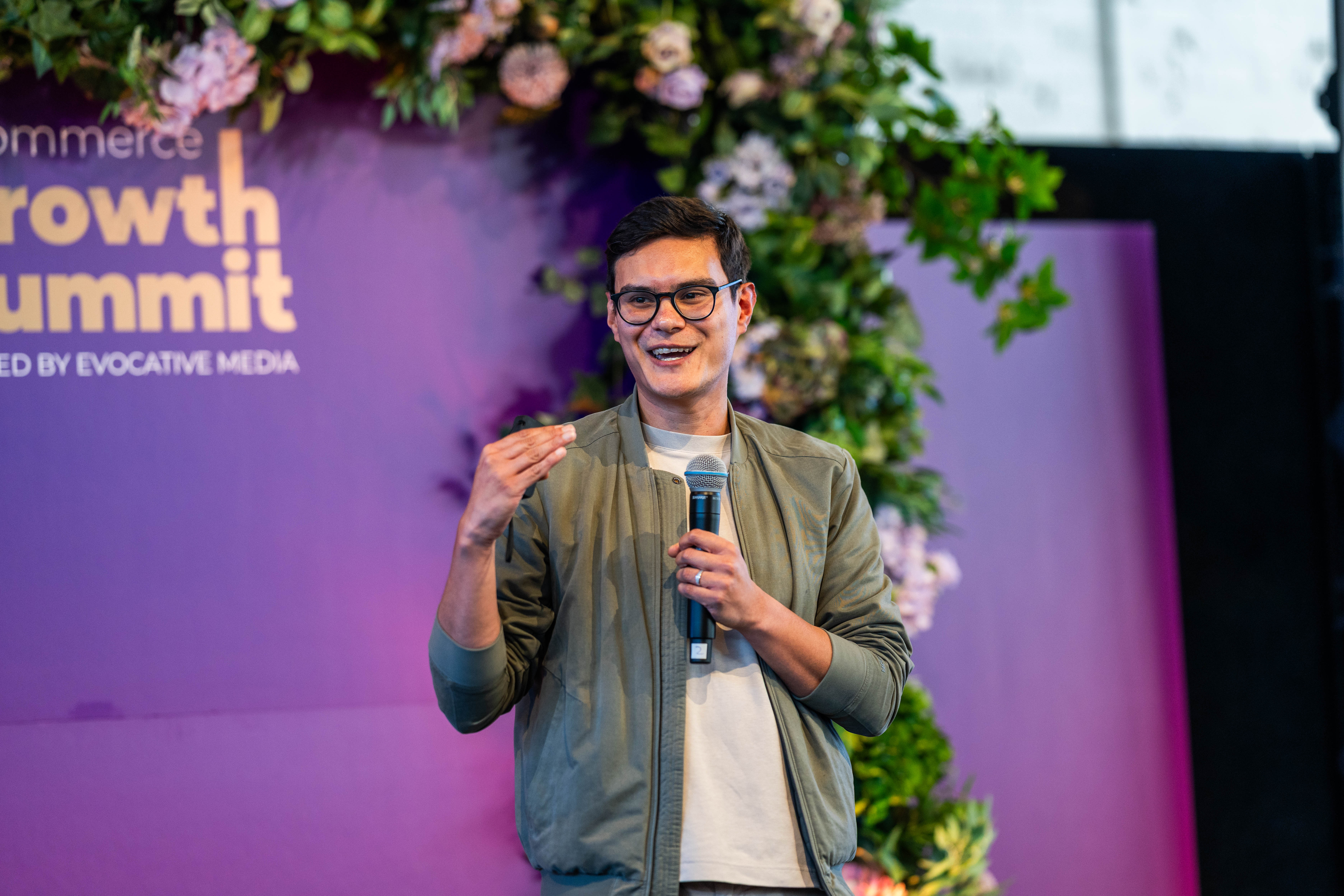
AI SEO consultant and AI search consultant helping brands appear in AI Overviews, AI Mode and ChatGPT. Chief of Staff at StudioHawk, Australia's largest dedicated SEO agency. Runs a measured three-channel playbook: Google, Bing and AI citations. Book a free consultation →