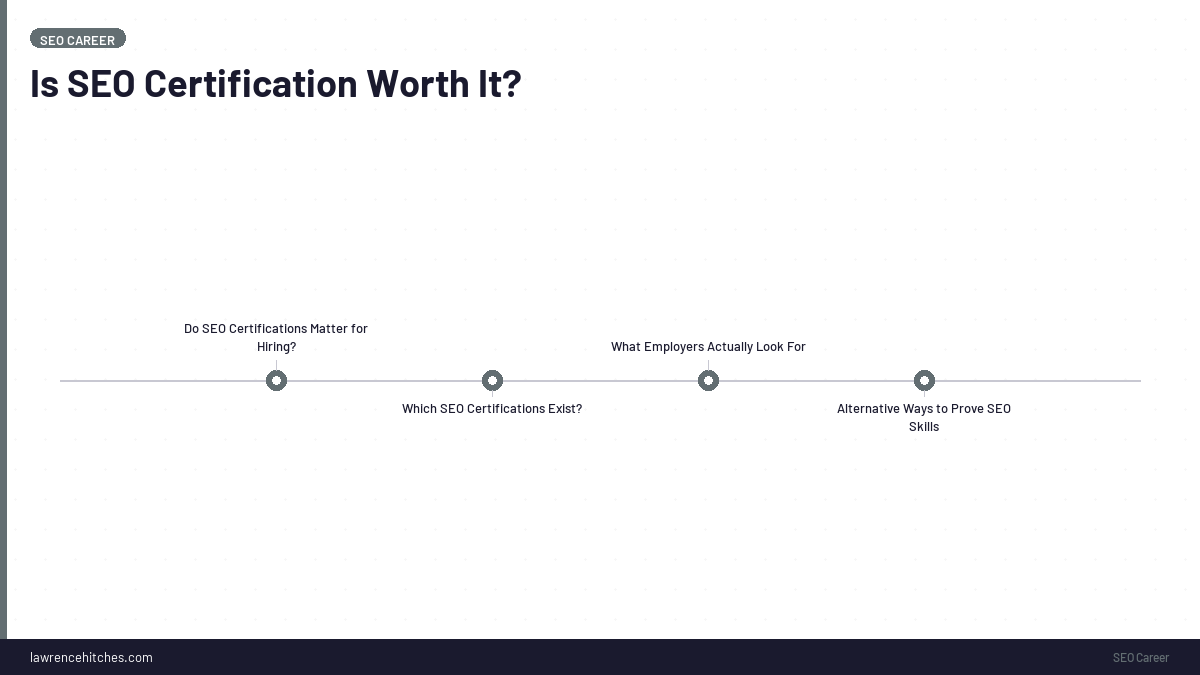
SEO certifications are worth doing for one reason and not the other. They are a genuinely useful way to learn the fundamentals in a structured order, and most of the good ones are free. They are close to worthless as a hiring signal. As someone who has hired and trained more than 50 SEO specialists, I have never once hired a candidate because of a certificate, and I have never rejected one for lacking it. What gets you hired is demonstrated work. This guide covers what SEO certifications actually do, which ones are worth your time in 2026, and the thing that beats a certificate every time.
What Is an SEO Certification?
An SEO certification is a course, usually online, that ends with a test or an assessment and issues a certificate or badge when you pass. They range from free fundamentals courses to paid programs that cost several hundred dollars.
The most recognised options in 2026:
- Google Analytics certification (free, via Google Skillshop). Not strictly SEO, but adjacent and widely held.
- HubSpot SEO certification (free). Beginner-friendly, marketing-platform-flavoured.
- Semrush Academy (free). Multiple SEO courses with certificates, tied to the Semrush toolset.
- Ahrefs Academy (free). Practical, tool-led training.
- Moz SEO Essentials (paid). A structured beginner certificate.
- SEO course certificates from independent educators (paid, variable quality).
Notice the pattern: the most reputable SEO certifications are free. That tells you something about what they are really for. They exist to teach you a vendor's tool or to bring new people into the discipline, not to gatekeep it.
What SEO Certifications Are Genuinely Good For
Certifications get unfairly dismissed. They do real work if you use them for the right job.
- Structured learning order. SEO is a sprawling discipline. A good course sequences the fundamentals so you do not learn crawling before you understand what indexing is. For a beginner, that ordering is worth a lot.
- A vocabulary baseline. After a course you can hold a conversation about canonicals, crawl budget, and search intent without bluffing. That matters in interviews and client calls.
- Tool fluency. The Semrush and Ahrefs certifications double as product training. If you are going to use those tools daily, the certificate course is the fastest way to learn them properly.
- Proof you can finish something. A certificate is weak evidence, but it is not zero evidence. It shows you completed a structured program. For a career-changer with no SEO history, that is a small positive signal.
What SEO Certifications Are Not Good For
Here is the honest part. A certification will not get you hired, and it will not get you clients.
SEO has no licensing body. There is no certificate that an employer is required to check, the way a trade or an accounting role works. Every SEO certification is issued by a company that benefits from issuing it. Hiring managers know this. When I review a CV, a list of certificates tells me the candidate completed some courses. It does not tell me whether they can actually move a site's rankings, which is the only thing I am hiring for.
The market is also flooded. A certificate that thousands of people hold is not a differentiator. By definition, a credential that is easy to get cannot make you stand out, because everyone competing for the same role has it too.
What I Actually Look For When Hiring an SEO
I have hired and trained more than 50 SEO specialists. Here is what moves a candidate from the maybe pile to the interview, in order of weight:
- A site you have actually worked on. Your own blog, a friend's business, a niche affiliate site, anything. If you can show me a URL and a before-and-after, you are ahead of 90% of applicants. It does not need to be a big result. It needs to be real and yours.
- The ability to explain your reasoning. I would rather hear a candidate explain why they chose to fix internal linking before chasing backlinks than hear them recite a definition. SEO is judgement under uncertainty. Show me the judgement.
- Evidence you keep learning. The discipline changes every quarter. A candidate who can tell me what changed in search this month is more valuable than one who memorised a course in 2024.
- Curiosity about measurement. The best SEOs are slightly obsessed with whether the thing they did actually worked. If you talk about testing and tracking unprompted, that is a strong signal.
A certificate appears nowhere on that list. Not because it is bad, but because it answers a question I am not asking.
Which SEO Certifications Are Worth Doing Anyway
If you are starting out, do the free ones, and treat them as learning tools rather than CV decoration:
- Ahrefs Academy or Semrush Academy for practical, tool-led fundamentals. You will use one of these tools in almost any SEO job, so the training pays off directly.
- HubSpot SEO certification if you are a complete beginner and want the gentlest possible on-ramp.
- Google Analytics certification because measurement literacy is non-negotiable and this one is genuinely respected.
Skip the expensive ones unless they include something a free course cannot: live mentorship, a real project review, or direct access to a practitioner who will critique your work. That feedback loop is worth paying for. A video library and a quiz is not.
The Better Alternative to a Certificate
If you have a weekend and you are deciding between starting a certification or doing something else, do this instead: build a real project and document it.
Register a cheap domain in a niche you find interesting. Publish ten genuinely useful pages. Set up Google Search Console. Track what happens over three months. Write up what you did, what worked, what did not, and why.
That single project teaches you more than any certificate, because you hit the real problems: a page that will not index, a keyword you cannot rank for, a competitor you cannot displace. And at the end you have the one thing that actually gets you hired, a real piece of work with your name on it and a measurable outcome.
A certificate says you watched the course. A documented project says you can do the job. Hiring managers can tell the difference instantly.
FAQ
Do you need a certification to work in SEO?
No. SEO has no licensing requirement and no mandatory credential. Most senior SEO professionals, including agency founders and directors, hold few or no formal certifications. Demonstrated work is the universal currency.
Are free SEO certifications as good as paid ones?
Usually better. The most reputable SEO certifications (Ahrefs, Semrush, HubSpot, Google) are free. Paid certifications are only worth it when they add live mentorship or real project feedback that a free course cannot provide.
Will an SEO certification help me get clients as a freelancer?
Marginally, at best. Clients hire on results and trust, not credentials. A case study showing a real outcome for a real site will win you far more work than any certificate.
Which SEO certification is most respected?
Among practitioners, the tool-led ones (Ahrefs Academy, Semrush Academy) carry the most practical weight because they prove tool fluency. The Google Analytics certification is the most widely respected adjacent credential. But "most respected" is relative, no SEO certification is a strong hiring signal on its own.
How long does an SEO certification take?
Most free SEO certifications take between three and ten hours of study plus a short assessment. Paid structured programs can run several weeks. The learning value is in the study, not the certificate at the end.
Related Reading
- How to Become an SEO Expert in 2026
- SEO Career Path: Every Role from Junior to Director
- What Does an SEO Specialist Do?
- Keyword Research for SEO in 2026: The Practitioner Workflow
Sources & Further Reading
Enjoying this? The 60-second versions live on Instagram.
Follow @lawrenceaiseo →Soaring Above Search
Weekly AI search insights from the front line. One newsletter. Six sections. Everything that actually moved this week, with a practitioner's take.
AI SEO consultant and AI search consultant helping brands appear in AI Overviews, AI Mode and ChatGPT. Chief of Staff at StudioHawk, Australia's largest dedicated SEO agency. Runs a measured three-channel playbook: Google, Bing and AI citations. Book a free consultation →