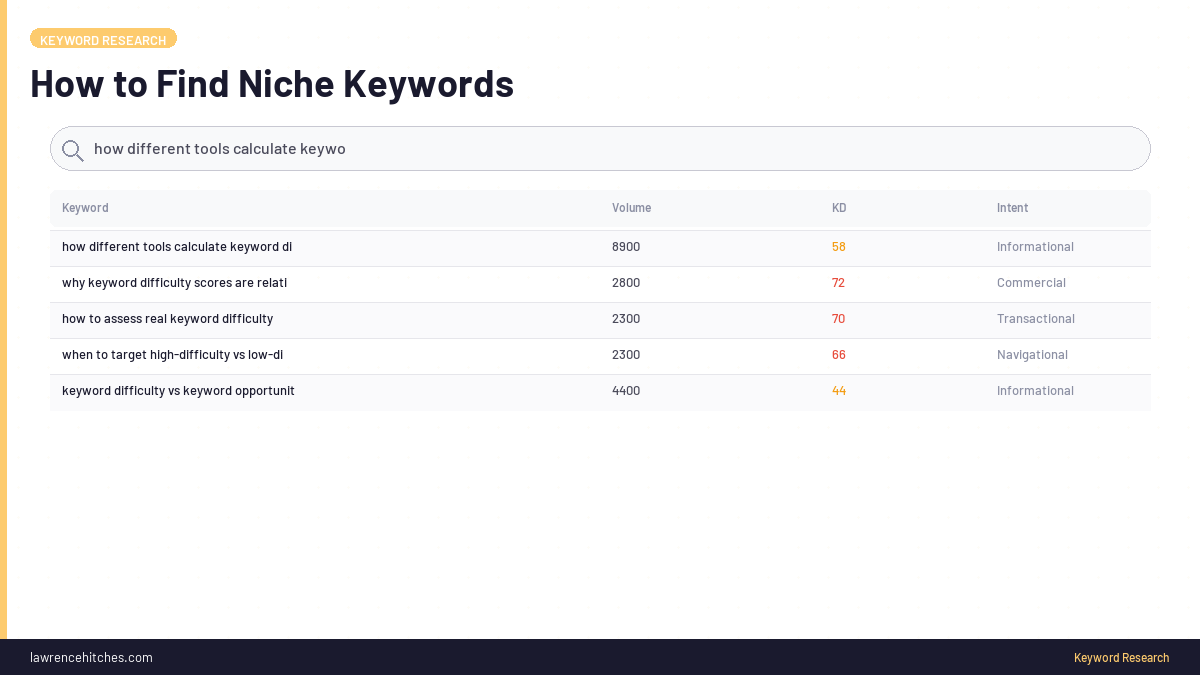
Keyword difficulty (KD) is a 0-100 score that estimates how hard it is to rank in the top 10 results for a target keyword. It is calculated by SEO tools like Ahrefs, Semrush and Moz using signals like the strength of currently-ranking domains, backlink profiles of top results, and domain-level authority of competitors. Lower scores mean easier keywords to rank for; higher scores mean more competition and more time, content depth, and backlinks required to break in.
Every major SEO tool has its own KD score, and they don't agree. Ahrefs, Semrush, Moz, SE Ranking and Mangools all calculate keyword difficulty differently. Two tools can show the same keyword as KD 28 and KD 67. That's not a bug. It's the result of each tool weighting different signals: Ahrefs leans heavily on referring domain count of top results, Semrush uses a blended authority and backlink model, and Moz incorporates a domain authority spread of the SERP.
The score is a directional input, not a verdict. Treat KD the same way you treat a forecast: useful for prioritising effort, useless as a guarantee. Below is how to actually read the score, what it gets wrong, and how to combine it with intent and SERP analysis to decide whether a keyword is worth chasing.
What Is Keyword Difficulty?
Keyword difficulty is an algorithmic estimate of how competitive a keyword is, expressed as a number on a 0-100 scale. The lower the score, the fewer or weaker the sites currently ranking on page one. The higher the score, the more entrenched the competition.
Most KD calculations look at three things:
- Backlink profiles of the top 10 results: how many referring domains each ranking page has, and how strong those domains are.
- Domain authority of currently-ranking domains: tools use proprietary metrics (Ahrefs DR, Moz DA, Semrush Authority Score) to estimate site-level strength.
- SERP feature density: ads, featured snippets, AI Overviews, image packs and other features compress the organic real estate, increasing functional difficulty even when the underlying competition is weak.
What KD scores do not measure: search intent match, content quality of competitors, brand authority signals, freshness, or whether AI Overviews are eating the SERP. All of these matter as much as raw difficulty in 2026.
How to Read KD Bands (in Practice)
The 0-100 scale is meant to be intuitive but it's not. Here's the practitioner reading from running KD comparisons across 300+ sites at StudioHawk:
- 0-20 (Easy): most new sites can rank inside 3-6 months with a focused content piece and a handful of internal links. The catch: these are usually long-tail or zero-volume keywords. The "easy" score reflects low competition, not high opportunity.
- 21-40 (Medium-low): realistic targets for sites with some existing authority (DR 20+) and decent content quality. Expect 6-12 months to break the top 10 with consistent effort.
- 41-60 (Medium): where most commercial intent keywords sit. Achievable for established sites (DR 40+) with strong topical authority and a backlink-earning strategy. 12-18 months is realistic.
- 61-80 (Hard): dominant brands and authoritative publishers own these. New entrants need either a niche differentiator (geo, vertical, demographic) or an unfair advantage (proprietary data, founder authority, exclusive partnerships).
- 81-100 (Very hard): head terms and category-defining keywords. Direct ranking is rarely the play. Better to target a specific sub-intent or a long-tail variant and let the larger ranking compound from there.
These bands are guides, not gates. A KD 75 keyword in a niche with no authoritative content can be easier than a KD 35 keyword in a saturated commercial vertical. Always look at the actual SERP before trusting the number.
Why Tools Disagree (and Which to Trust)
I've run the same 200-keyword list through Ahrefs, Semrush, Moz and Mangools. The KD scores correlate at roughly r=0.6, which means they agree on the rough order but disagree heavily on absolute values. A keyword Ahrefs calls KD 35 might be Semrush KD 58 and Moz KD 22.
The differences come down to the input data and weighting:
- Ahrefs KD is based on the number of referring domains the lowest-ranking page in the top 10 has. Referring domain count is its primary signal. Tends to score commercial keywords lower than other tools.
- Semrush KD% blends domain authority of top results, backlink profile, content quality signals, and SERP feature density. Generally produces higher scores than Ahrefs.
- Moz KD uses Domain Authority and Page Authority of top results plus a difficulty rating Moz calculates separately. Tends to be the most conservative (lowest scores) for branded or featured-snippet keywords.
- Mangools KD uses a simplified domain strength model. Best for quick gut-check on long-tail keywords; less reliable for commercial competitive terms.
Practitioner take: don't trust any single KD score. Use whichever tool you're already paying for and treat it as one input alongside SERP analysis and intent. If you have multiple tools, average the scores or use the highest as your conservative estimate.
Using KD to Find Niche Keywords
Niche keywords are where KD becomes genuinely useful. The pattern: filter your seed keyword list to KD 0-30, then layer intent and search volume filters on top to find keywords with manageable competition and real search demand.
Here's the workflow:
- Seed list expansion: start with 20-30 broad keywords in your niche. Use Ahrefs Keyword Explorer or Semrush Keyword Magic Tool to expand to 1,000+ related keywords.
- Filter by KD: set the maximum KD to 30. This cuts the list dramatically and surfaces only the easier opportunities.
- Filter by volume: set minimum monthly search volume to 50-100 (depending on your vertical). Excludes zero-volume keywords that look easy because no one's competing for them.
- Filter by intent: prioritise commercial and transactional intent keywords. Informational keywords are increasingly being eaten by AI Overviews, so the click-through is degraded.
- SERP check the survivors: open the top 10 for each remaining keyword. If the SERP is dominated by Reddit, Quora, low-quality content farms or thin pages, your odds are good. If it's dominated by category leaders (Amazon, Wikipedia, major publications), the KD score is misleading and you should skip.
This filter cascade typically reduces a 1,000-keyword list to 30-80 genuine niche opportunities you can prioritise.
KD in the Age of AI Overviews
One thing the major SEO tools have not yet reflected in their KD calculations: AI Overview presence on the SERP. A keyword with KD 25 on Ahrefs might have an AI Overview occupying the top 60% of mobile real estate, meaning even ranking #1 organic gets a CTR drop of 40-60% compared to AI Overview-free SERPs.
Practitioner adjustment: when evaluating keyword difficulty in 2026, layer two new signals on top of the standard KD score:
- AI Overview presence: search the keyword in an incognito window. If an AI Overview appears, mentally add 15-25 points to the KD because of the click-through dilution.
- SERP type alignment: if the keyword is informational and AI Overviews are present, the KD is irrelevant, you're competing for citation, not position. Build for AI citation (structured data, clear answers, factual depth) rather than rank.
For commercial keywords (intent to purchase, hire, sign up), AI Overviews appear less often and the standard KD score is still a reliable input. For informational keywords, the displayed KD has become an undercount of true difficulty.
KD vs Competition Score (Ads)
Don't confuse keyword difficulty with the "competition" score in Google Keyword Planner. They measure entirely different things.
- Keyword difficulty (Ahrefs, Semrush, Moz): an organic SEO metric. Estimates how hard it is to rank in the top 10 organic results.
- Competition (Google Keyword Planner): a paid search metric. Estimates how many advertisers are bidding on the keyword in Google Ads.
A keyword can have low organic KD and high paid competition (lots of advertisers bidding, but weak organic competitors). Or high organic KD and low paid competition (few advertisers, but the SERP is locked up by authoritative organic results). Look at both signals when deciding whether a keyword is worth pursuing across paid and organic channels.
FAQ
What is a good keyword difficulty score?
For a new site or low-authority domain (DR under 20), aim for KD 0-25. For established sites (DR 30-50), KD 30-55 is realistic. For high-authority brands (DR 60+), most KD scores are achievable; the question becomes ROI on the content investment, not raw feasibility.
Should I avoid high keyword difficulty keywords?
Not always. High-KD keywords often have high commercial value, and the long-term play is to build sub-topic and supporting content that compounds toward the head term. Avoid them if you need traffic in the next 6 months. Pursue them as part of a 12-24 month topical authority strategy.
How accurate is keyword difficulty?
Roughly directional. Tool KD scores correlate with each other at r=0.6, meaning they agree on the rough order but not absolute values. Combined with SERP analysis and intent matching, KD is a useful prioritisation input. Used in isolation, it's misleading.
Do AI Overviews affect keyword difficulty?
Indirectly. AI Overviews don't change the underlying ranking competition, but they reduce CTR for organic results, especially for informational queries. A keyword with KD 25 and AI Overview present has effectively higher functional difficulty because the click-through is degraded. Most SEO tools haven't yet incorporated AI Overview presence into KD calculations.
What's the difference between KD and SERP difficulty?
KD measures the strength of currently-ranking domains. SERP difficulty (a newer concept some tools are introducing) measures the structural difficulty of the SERP itself: ad density, featured snippets, AI Overviews, image packs, and other features that compress organic real estate. SERP difficulty is increasingly the more useful metric for predicting actual click volume.
Related Reading
- Keyword Research for SEO in 2026: The Practitioner Workflow
- How to Win Low Hanging Fruit Keywords
- Fat Head Keywords: Definition, Examples, and Strategy
- Chunky Middle Keywords for SEO
- Head Terms vs Long-Tail Keywords
- Keyword Difficulty (glossary entry)
Sources & Further Reading
Enjoying this? The 60-second versions live on Instagram.
Follow @lawrenceaiseo →Soaring Above Search
Weekly AI search insights from the front line. One newsletter. Six sections. Everything that actually moved this week, with a practitioner's take.

AI SEO consultant and AI search consultant helping brands appear in AI Overviews, AI Mode and ChatGPT. Chief of Staff at StudioHawk, Australia's largest dedicated SEO agency. Runs a measured three-channel playbook: Google, Bing and AI citations. Book a free consultation →