Low-hanging fruit keywords are queries your site already ranks for at positions 11-20 (the second page of Google) with real impressions but few or no clicks. They are the highest-leverage SEO target on any site because the ranking work is already done. Pushing a position 14 ranking to position 7 is faster, cheaper, and more predictable than building a brand new page from scratch.
The trap most site owners fall into: chasing every page-2 keyword equally. In 2026, that's wrong. AI Overviews have changed which low-hanging fruit are worth chasing and which aren't. Below is the exact workflow: where to find them, which ones to prioritise, the AI Overview filter to apply, and the anti-patterns that waste content cycles.
What Are Low-Hanging Fruit Keywords?
Low-hanging fruit keywords have three defining characteristics:
- You already rank for them. The page exists, Google has crawled it, the URL appears in SERPs.
- Position is in the 11-20 range (second page). Some practitioners include 4-10 (page-1 striking distance), but the cleanest LHF definition is 11-20 because that's where a single targeted improvement can move the page to page 1, where 90% of clicks happen.
- The keyword has measurable impressions over a 28-90 day window. A keyword with 1 impression in 90 days isn't low-hanging fruit; it's noise. Set a minimum impression threshold (I use 25 imps over 90 days) to filter signal from noise.
The reason these keywords are "low-hanging" is that the hardest part of SEO (getting Google to crawl, index, and rank the page at all) is done. The remaining work is incremental: better headings, better intent matching, deeper content, internal links pointing in. That work usually takes 1-3 hours per page versus 8-15 hours to build a new ranking page from scratch.
How to Find Low-Hanging Fruit Keywords with GSC
Google Search Console is the canonical source. The exact filter:
- Open Performance > Search results
- Set the date range to last 28 days (last 90 days is also fine for a fuller view)
- Click Average position to enable that metric column
- Sort the queries table by impressions descending
- Filter by position: greater than 10 AND less than 21 (this is the 11-20 LHF range)
- Filter out branded queries and obvious irrelevant queries (your name, your competitor's name, navigation queries)
- What remains is your LHF list, sorted by opportunity size (impressions = potential traffic if you ranked higher)
For each candidate, click into the query to see which page is ranking. That's the page that needs the refresh, not a new page.
How to Find Low-Hanging Fruit Keywords with SEOtesting
SEOtesting wraps the GSC API and adds a striking-distance report that does this filter automatically. The workflow:
- Open Reports > Striking Distance Keywords
- The default filter is positions 4-15, but you can tighten to 11-15 to get a pure LHF view
- Sort by impressions descending
- Each row shows the query, the ranking page, current position, and 28-day impression count
- Export to CSV for batch refresh planning
I use SEOtesting weekly. The striking distance report alone justifies the subscription for any site doing more than 30 hours of content work per month, because finding 5-10 LHF candidates per session compounds across years.
The 2026 AI Overview Filter (Which LHF to Skip)
Here is what's changed since 2024: ranking position 7 for an informational query that triggers an AI Overview generates 60-80% fewer clicks than ranking position 7 for a commercial query without an AI Overview. Same position, same impressions, dramatically different traffic.
This means your LHF list needs a second filter: AI Overview presence. Apply it manually:
- Open the top 5-10 LHF queries in an incognito browser. If an AI Overview appears at the top of the SERP, mark the keyword as "AI Overview present".
- For AI Overview queries: keep them on the list only if the intent is commercial or transactional. Skip them if the intent is informational ("what is X", "how does X work", "X explained"). The click-through dilution makes the refresh effort uneconomic.
- For non-AI-Overview queries: prioritise these. The full traffic upside is intact.
This single filter typically removes 30-40% of the LHF list and concentrates effort on the keywords where ranking improvements still translate into real clicks.
Real Example: Low-Hanging Fruit Keywords from Bing
Bing Webmaster Tools is my second-favourite LHF source after GSC. Bing surfaces longer-tail and more LLM-shaped queries that Google drowns in noise. Recent example from this site:
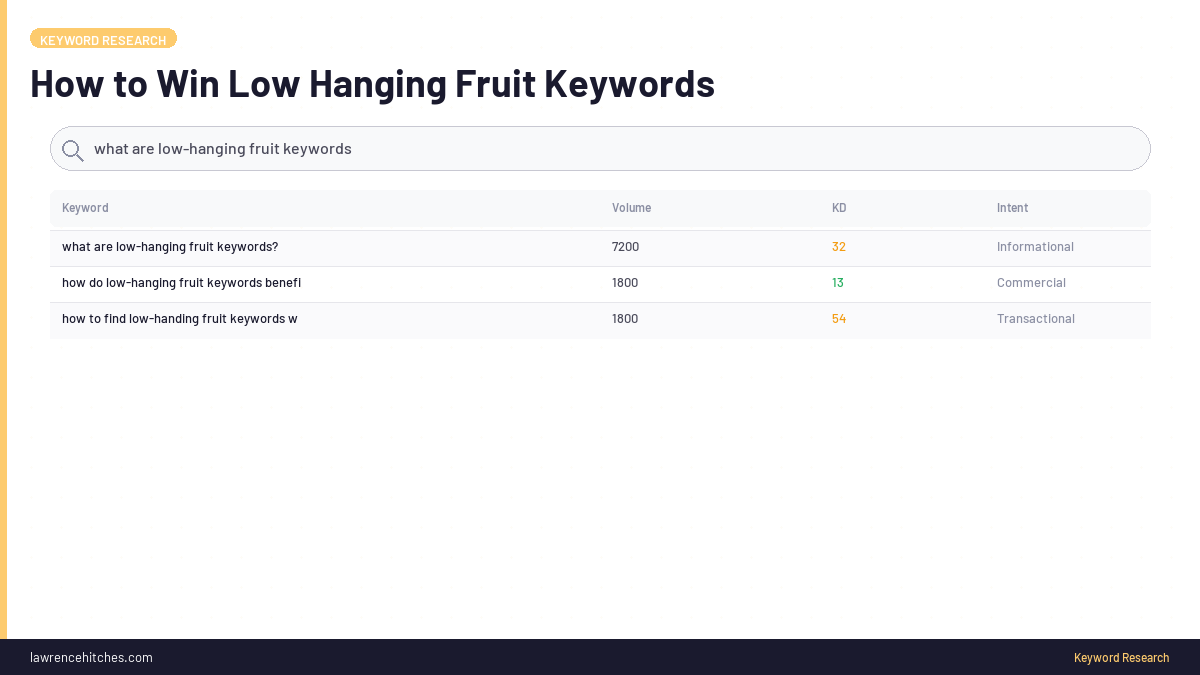
Pulled the Bing CSV in early May. Spotted "low-hanging fruit keywords" sitting at position 60 with 1 impression. Ran the refresh on the page targeting that keyword. Within 7 days the same query showed 53 impressions at position 60 in Google (cross-engine signal: when Bing notices, Google often follows). The page started ranking for adjacent variants ("how to find low-hanging fruit keywords", "how to find low hanging fruit keywords") that weren't on the original list.
This is the meta-validation: the page you're reading right now is itself a low-hanging fruit refresh, executed in May 2026 against a Bing-sourced signal. The methodology compounds.
The LHF Refresh Workflow
Once you've identified the candidates, the actual refresh follows a tight pattern:
- Open the page and the top 3 ranking competitors for the target query side by side
- Identify the intent gap: does your page answer the same question competitors answer? If not, fix that first
- Identify the depth gap: do competitors cover sub-topics or specifics your page doesn't? Add the missing depth
- Add a snippet-lead intro (50-150 words bolded, directly answers the query). This single change often moves a page 3-5 positions because Google rewards clear answer formats
- Update the publish date to today. Yes this matters for AI engines that weight recency
- Add 2-3 internal links from related cluster pages pointing in to the refreshed page (anchor text should be a natural variant of the target query)
- Push live and annotate in SEOtesting. Wait 14-21 days for the new ranking signal to settle
Most LHF refreshes take 1-3 hours. The position move usually happens within 14-21 days. Track in SEOtesting via the page-level annotation system so you can attribute movement to the refresh, not external noise.
Anti-Patterns: Which LHF NOT to Chase
Not every page-2 ranking is worth refreshing. Skip these:
- Branded queries you don't own. If you're ranking position 14 for "[competitor name] alternative" and they have 1,000x your authority, pushing to page 1 takes more effort than building a new page targeting an unbranded variant.
- Zero-CTR keywords after 12+ weeks at top of page 1. If a keyword has been at position 4-7 for 3 months with 0 clicks, the SERP itself is probably eating the traffic (AI Overview, featured snippet, ad density). Refreshing won't help.
- Long-tail informational queries with AI Overviews. See the 2026 filter above. Effort doesn't pay back.
- Queries that don't match the page's true intent. If you're accidentally ranking position 14 for a keyword the page wasn't built for, refreshing the page to better target that keyword often loses you the rankings on the keywords you do want.
FAQ
What position counts as low-hanging fruit?
Most practitioners use positions 11-20 (page 2 of Google), where a targeted refresh can push the page to page 1. Some include 4-10 as "striking distance" (page 1 but not visible above the fold). Below position 20 is usually too far to be classified as low-hanging fruit because the work to break into the top 20 is significantly more than the work to climb within it.
How many low-hanging fruit keywords should I have?
Most established sites with 50+ pages and any SEO history have between 20 and 200 LHF keywords at any time. The list refreshes constantly as you push some to page 1 and others fall back to page 3. A weekly review cadence keeps the list fresh.
How long does it take to rank a low-hanging fruit keyword?
Typically 14-21 days from a refresh to see ranking movement. Some take longer if Google is in a re-evaluation phase or if the SERP itself is volatile. Track via SEOtesting annotations and don't declare the test failed until at least 28 days post-refresh.
Are low-hanging fruit keywords still worth chasing in 2026?
Yes, but with more selectivity than in 2023. AI Overviews on informational queries reduce the click upside even when ranking improves. Apply the AI Overview filter (commercial intent only when AI Overview is present) and you'll concentrate effort on the LHF that still translates to real traffic.
What's the difference between LHF and striking distance keywords?
Same idea, different boundary. LHF is typically positions 11-20. Striking distance is typically positions 4-15 (overlapping with LHF but extending into page 1 not-yet-visible). Both refer to the same workflow: find queries that are close to ranking, refresh the page, push them up. Use whichever term you prefer; the methodology is identical.
Related Reading
- Keyword Research for SEO in 2026: The Practitioner Workflow
- Keyword Difficulty: What It Is and How to Use It
- Keyword Modifiers: How to Use Them to Rank in 2026
- Chunky Middle Keywords for SEO
- SEO Trends: Weekly Practitioner Watch List
Sources & Further Reading
Enjoying this? The 60-second versions live on Instagram.
Follow @lawrenceaiseo →Soaring Above Search
Weekly AI search insights from the front line. One newsletter. Six sections. Everything that actually moved this week, with a practitioner's take.

AI SEO consultant and AI search consultant helping brands appear in AI Overviews, AI Mode and ChatGPT. Chief of Staff at StudioHawk, Australia's largest dedicated SEO agency. Runs a measured three-channel playbook: Google, Bing and AI citations. Book a free consultation →