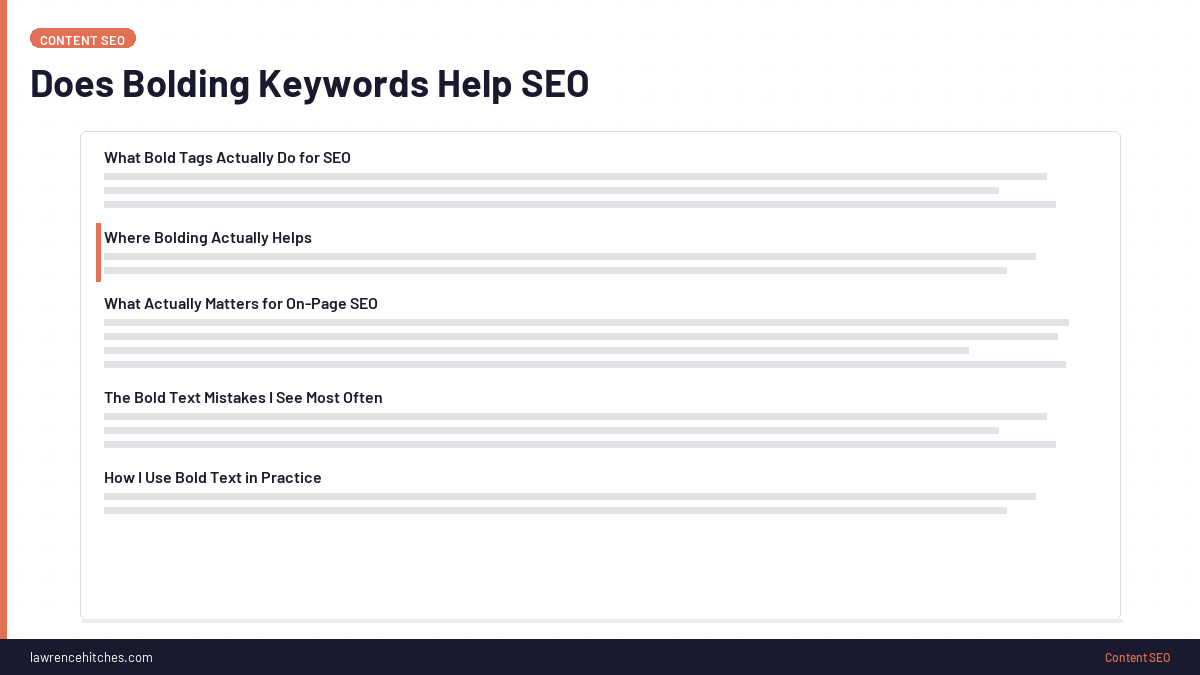
Yes, bolding key terms in your content helps SEO, but only when used sparingly. Google's John Mueller confirmed in 2021 that bolding (<strong> or <b>) helps Google understand which parts of a page are most important. In 2026, with AI search engines like ChatGPT, Perplexity, and Google AI Overviews extracting passages from web pages to cite, bolded text has become an even stronger extraction signal. The catch: bold everything and you signal nothing. This guide covers what works, what doesn't, and how to use bold text for both human readers and AI extraction in 2026.
Does Bolding Keywords Actually Help SEO in 2026?
Short answer: yes, modestly, when used correctly.
The clearest official guidance comes from Google's John Mueller in a November 2021 SEO office hours:
"When you have a longer text, maybe a paragraph, a couple of paragraphs, then maybe within that text you have certain sentences or words that you have in bold or in italics, that does help us a little bit to understand that this is critical to this page, this is what the page is about. So if there's certain words that you really want to focus on, then it can totally make sense to use bold or italics to highlight those keywords."
That's the strongest official statement we have. Bolded text is a relevance signal, not a ranking factor in the traditional sense. It helps Google understand which terms on a page matter most, which can influence which queries the page surfaces for.
Why Bolding Matters More for AI Search in 2026
Here's what changed since 2021. AI search engines, ChatGPT, Perplexity, Claude, Google AI Overviews, extract passages from web pages and cite them in answers. The extraction logic isn't documented publicly, but pattern analysis of cited content suggests bolded sentences are extracted at a meaningfully higher rate than unbolded text in the same paragraph.
Why? Because bolded text functions as a built-in "pull quote" signal. The author has explicitly told the parser: "this sentence is the answer." AI extraction systems trained on human-curated content treat bold as a high-confidence indicator of the key claim.
In practice, the pages that get cited most often in AI Overviews and Perplexity tend to share three patterns:
- A bold "snippet-lead" sentence at the top of the article that directly answers the page's primary query
- One bolded "answer sentence" under each H2, restating the H2 as a declarative claim
- Sparing use elsewhere, maybe 2-4 additional bolded phrases per 1,000 words, marking key terms
If your content has 30+ bolded phrases per article, you've diluted the signal. Bold everything and AI extraction systems treat bold as decoration, not emphasis.
Bold vs. Strong: Does the HTML Tag Choice Matter for SEO?
Both <b> and <strong> render visually as bold, but they're semantically different in HTML5:
<strong>indicates content with strong importance, seriousness, or urgency. The semantic tag.<b>draws attention to the text without indicating importance. The presentational tag.
For SEO purposes, John Mueller has said Google treats them the same way as a weighting signal. For accessibility and AI extraction, <strong> is the better choice, screen readers handle it differently, and AI parsers reading the raw HTML put more weight on the semantic tag.
Practical rule: use <strong> for content emphasis. Use <b> only when you genuinely just need bold visual styling without semantic weight (e.g. product names in a list).
How to Use Bold for SEO and AI Extraction (Without Overdoing It)
The framework I use across StudioHawk client content in 2026:
1. The Snippet-Lead Sentence
Open every article with a bolded sentence (50-150 words) that directly answers the article's primary query. This sentence is what AI engines lift into their summaries. It's also what Google often pulls into featured snippets.
Example, for an article targeting "what is canonical tag":
A canonical tag is an HTML element (
<link rel="canonical" href="...">) that tells search engines which version of a page is the master copy when multiple URLs serve similar content. Used correctly, it consolidates ranking signals onto a single URL and prevents duplicate-content issues. Used badly, it can quietly de-index pages you wanted to rank.
2. One Answer Sentence per H2
Under each H2 heading, write a 1-2 sentence answer to the implicit question the H2 raises, and bold it. This is the highest-citation pattern across AI search engines I've audited.
3. Mark Critical Terms Sparingly
2-4 additional bolded phrases per 1,000 words, used to highlight: technical terms readers might skim past, contrarian claims that anchor your argument, or specific recommendations the reader should remember.
4. Don't Bold Headings
Headings (<h2>, <h3>) are already styled as bold in CSS, wrapping them in additional <strong> tags is redundant and signals nothing.
5. Don't Bold Whole Paragraphs
If three sentences in a row are bold, none of them are emphasised. The signal collapses.
Common Bold Text Mistakes That Hurt SEO
From auditing client content at StudioHawk, the most common bolding mistakes:
- Bolding every keyword variant. If your target keyword appears 12 times in the article and 9 of them are bold, you've signalled nothing, you've just created a visually noisy page.
- Bolding for visual emphasis, not semantic weight. Designers often bold lead-ins or list intro phrases for layout reasons. Use CSS classes for that. Reserve
<strong>for actual content emphasis. - Bolding navigation, footer, or boilerplate text. The signal should be content-relevant, not site-wide. If your "Sign up for our newsletter" CTA is in
<strong>, you're telling Google your newsletter pitch is one of the most important things on every page. - Auto-bolding from AI writing tools. ChatGPT and Claude both have a tendency to bold the first 3-4 words of every paragraph. Strip these out before publishing, they're decorative, not semantic.
- Inconsistent bold patterns across the site. If half your articles use bold extensively and half not at all, the signal is noisy. Pick a content style guide and apply it consistently.
What About Italic, Underline, and Other Emphasis Tags?
Italic (<em>) carries similar but lighter weight than bold. Underline (<u>) is generally avoided in web content because users associate it with links, using it for emphasis hurts UX and provides no SEO benefit. Highlight (<mark>) is rarely indexed as a relevance signal but works well for AI extraction when used sparingly.
The hierarchy I use:
- Bold (
<strong>): primary emphasis, key claims, snippet-lead sentences - Italic (
<em>): secondary emphasis, technical terms on first mention, foreign words, titles of works - Underline (
<u>): never, except in legal/disclaimer contexts where convention requires it - Highlight (
<mark>): occasional pull-quote use; treat as a bolder bold
FAQ: Bolding Keywords for SEO
Does Google count bolded text as a ranking factor?
Not as a direct ranking factor, but as a relevance signal. John Mueller has confirmed Google uses bold and italic emphasis to better understand which parts of a page are most important. Used sparingly, it modestly influences which queries a page surfaces for. Used excessively, it provides no signal.
Should I bold every instance of my target keyword?
No. Bold only the first instance of the target keyword (if natural) and 2-4 other key terms or claims per 1,000 words. Bolding every keyword instance dilutes the emphasis signal and creates visually cluttered content.
Is <strong> better than <b> for SEO?
For SEO purposes, Google treats them the same. For accessibility and AI search extraction, <strong> is preferred because it carries semantic meaning ("this content has strong importance") while <b> is purely presentational. Use <strong> for content emphasis.
Does bolding help with featured snippets?
Yes, indirectly. Featured snippets are typically pulled from the first paragraph or a clearly-defined answer block. Leading with a bolded "snippet-lead" sentence that directly answers the query increases the chance Google selects your content for the snippet. The same pattern holds for AI Overviews and ChatGPT citations.
Does bolding text help with AI search citations?
Yes. AI extraction systems (ChatGPT, Perplexity, Claude, Google AI Overviews) treat bolded sentences as high-confidence answer candidates. Pages that lead each section with a bolded one-sentence answer to the section's implicit question get cited more often than pages with no emphasis structure.
Can over-bolding hurt SEO?
Indirectly, yes. Excessive bolding doesn't trigger a penalty, but it (a) collapses the relevance signal because nothing stands out, (b) hurts readability and user engagement, which feed into Google's quality signals, and (c) can be flagged as low-quality content by AI extraction systems trained on professionally-edited writing.
Should I bold headings?
No. <h2>, <h3>, etc. are already styled bold by browser defaults and your site's CSS. Adding <strong> tags inside headings is redundant and provides no additional SEO signal.
Sources & Further Reading
- John Mueller (Google) on bold text and SEO, November 2021 office hours
- MDN: <strong> element specification
- MDN: <b> element specification
Keep Reading
- Header Tags: SEO Best Practices for H1-H6
- AI Citation Mechanics: How AI Search Engines Choose What to Cite
- How to Win Featured Snippets in 2026
- Keyword Research: A Practitioner Guide
Sources & Further Reading
Enjoying this? The 60-second versions live on Instagram.
Follow @lawrenceaiseo →Soaring Above Search
Weekly AI search insights from the front line. One newsletter. Six sections. Everything that actually moved this week, with a practitioner's take.
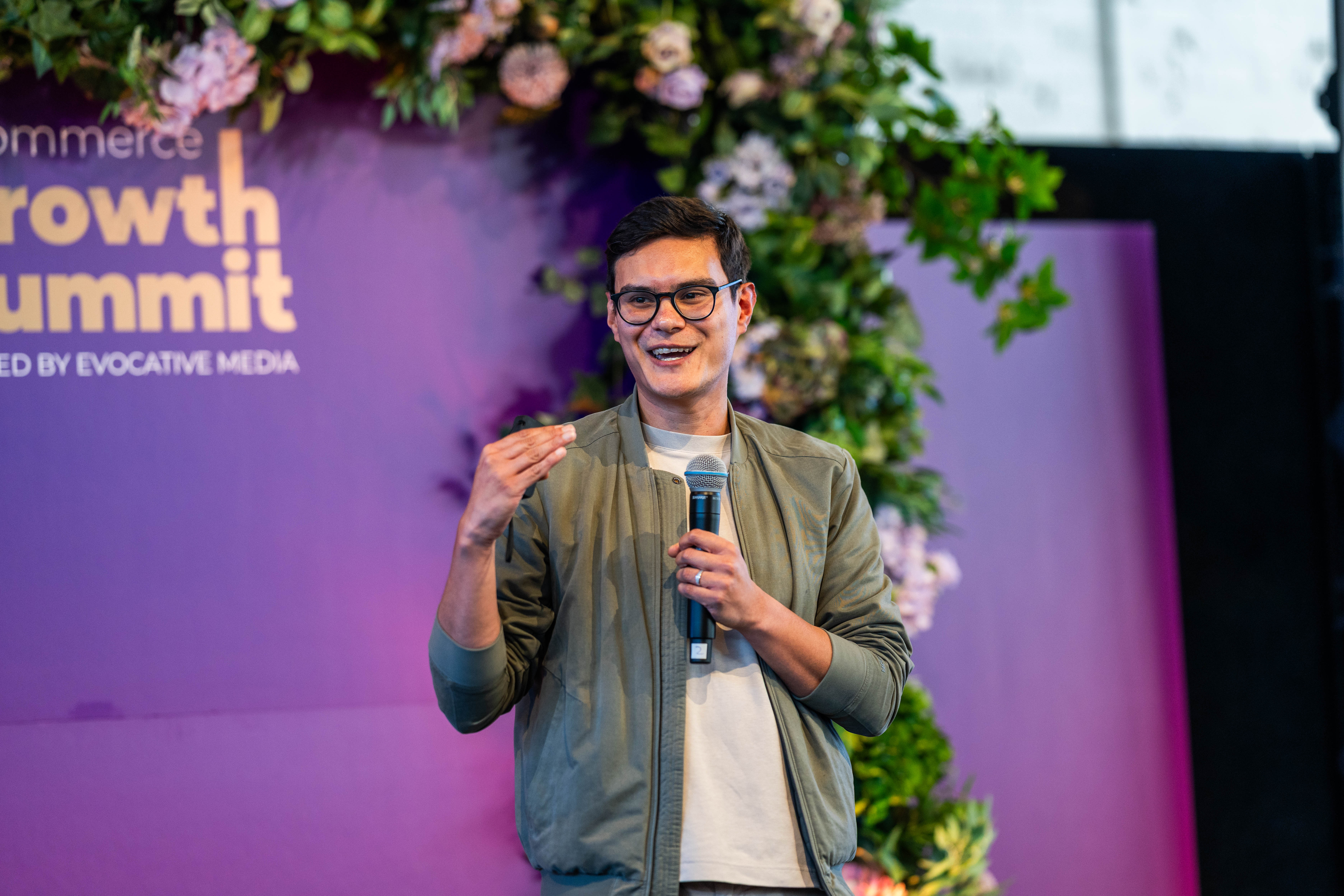
AI SEO consultant and AI search consultant helping brands appear in AI Overviews, AI Mode and ChatGPT. Chief of Staff at StudioHawk, Australia's largest dedicated SEO agency. Runs a measured three-channel playbook: Google, Bing and AI citations. Book a free consultation →