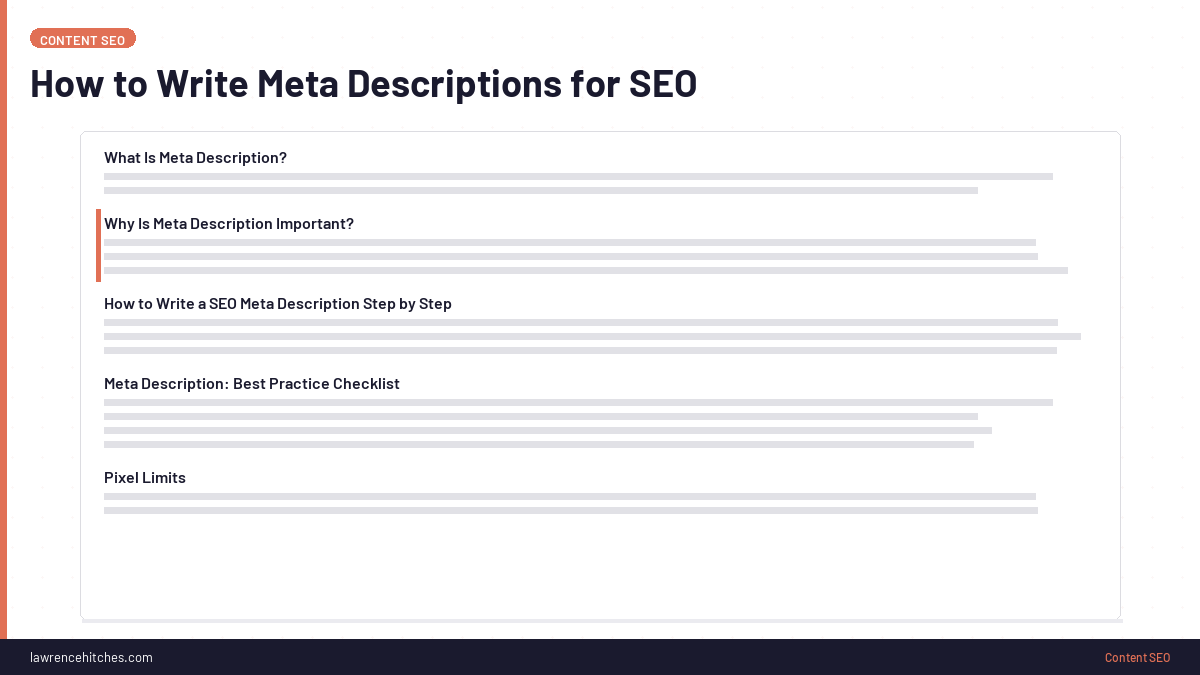
A meta description is the short summary (under 160 characters, ideally 140-155) that appears beneath your page title in Google and Bing search results. Google rewrites them about 70% of the time in 2026, but the ones it keeps drive measurable CTR uplift, and the ones it rewrites still inform AI search engines (ChatGPT, Perplexity, Claude, AI Overviews) on what your page is about. Writing them well is one of the cheapest CTR levers in SEO. This guide covers the 2026 best-practice formula, the rewrite trap most teams fall into, and how to test meta descriptions properly.
What Is a Meta Description?
The meta description is an HTML element that lives in the <head> of your page:
<meta name="description" content="Your page summary here, 140-155 characters.">Search engines use it as a candidate snippet in the SERP, the grey text under your title. They also use it as a structural signal for what your page is about, which feeds AI search engines and is one of the inputs to query-page matching.
It's not a direct ranking factor (Google has been clear about this since 2009). But CTR is. And the meta description is the single biggest lever you have over CTR after the title.
Why Meta Descriptions Still Matter in 2026
Three reasons the meta description is more important in 2026, not less:
- SERP CTR. When Google keeps your meta description, a well-written one outperforms a poorly-written one by 30-80% in CTR for the same ranking position. That's a multiplier on every visit you'd otherwise miss.
- AI search citation context. AI search engines parse meta descriptions as a high-signal summary of what the page is about. Pages with clear, accurate meta descriptions get cited more reliably than pages with auto-generated or boilerplate summaries.
- Bing and other engines rewrite less aggressively. Google rewrites ~70% of meta descriptions; Bing rewrites significantly less. With Bing now powering ChatGPT search and Microsoft Copilot, your written meta description has more direct impact on AI-mediated traffic than ever.
How Often Does Google Rewrite Meta Descriptions?
According to widely-cited 2022 research from Portent (and confirmed across multiple subsequent studies), Google rewrites the meta description on roughly 62-70% of pages. The rewrite rate is higher for:
- Generic, boilerplate descriptions ("Welcome to our website. Click to learn more.")
- Descriptions that don't match the user's specific query
- Descriptions that exceed the pixel limit and get truncated
- Descriptions that don't appear semantically related to the page content
Google's reasoning: the user's specific query needs a tailored snippet. If your generic meta description doesn't match what the searcher actually asked, Google pulls a relevant passage from the page body instead.
The takeaway: writing a meta description isn't a guarantee Google will use it. But writing a good one, specific, query-aligned, the right length, significantly increases the probability Google keeps it. And even when Google rewrites it, your written version still informs the LLM systems behind AI search.
The 2026 Meta Description Formula
The structure I use across StudioHawk client pages:
[Lead with the answer to the primary query (~50-70 chars)] + [Specific differentiator or benefit (~40-50 chars)] + [Soft CTA or natural close (~30-40 chars)]
Example, for a page targeting "best SEO tools 2026":
The best SEO tools for 2026, ranked by what they actually solve. Free vs paid options for keyword research, technical audits, and AI search tracking. From a working SEO consultant.
Three things this does:
- Lead delivers the answer. Anyone reading the SERP gets the value proposition immediately.
- Differentiator earns the click. "From a working SEO consultant" tells the user this is practitioner content, not affiliate ranking.
- Stays under 155 characters. Won't be truncated by Google's pixel limit on either desktop or mobile.
Length Guidelines: Pixel Limits in 2026
Google doesn't enforce a hard character count, they enforce a pixel limit:
- Desktop SERP: ~920 pixels (roughly 155-160 characters in standard fonts)
- Mobile SERP: ~680 pixels (roughly 120 characters)
Practical advice:
- Target 140-155 characters for a description that displays in full on desktop without truncation
- Front-load the most important content in the first 120 characters so it survives mobile truncation
- Don't pad with filler just to hit a length. Short, sharp descriptions often outperform longer ones that get truncated mid-thought
How to Write Meta Descriptions Step by Step
Step 1: Identify the Primary Query the Page Targets
What's the one query you most want this page to rank for? Your meta description leads with the answer to that query. If the page targets multiple queries, write for the highest-volume commercial intent.
Step 2: Write the Snippet-Lead Sentence
50-70 characters that directly answer the implicit question in the query. For "what is canonical tag," that's: "A canonical tag tells search engines which version of a page is the master copy."
Step 3: Add the Differentiator
40-50 characters explaining what makes your page worth clicking over the others on the SERP. Specific data, named credentials, or a concrete benefit. Avoid generic phrases like "comprehensive guide" or "everything you need to know", they're SEO filler that signals nothing.
Step 4: Close with Natural Action or Hook
30-40 characters that complete the thought. This isn't a hard CTA ("Click here to learn more!" reads like spam). It's a natural close that leaves the reader wanting to click. "From a working SEO consultant" is a natural close. "With paste-ready code examples" is a natural close.
Step 5: Read It Back as a SERP Listing
Open Google. Search for your target keyword. Mentally paste your meta description in. Does it stand out among the other listings? If every listing on the page sounds the same, your description has no edge.
Step 6: Test and Iterate
Track CTR for the page in Google Search Console (Performance report → individual page). If CTR is below 2% on a page ranking position 1-5, the meta description (or title) is the bottleneck. Test alternatives.
Writing Meta Descriptions for AI Search (2026)
The new layer in 2026: AI search engines parse meta descriptions as a high-confidence summary signal. Pages get cited in AI Overviews, ChatGPT search, Perplexity, and Claude based partly on whether the meta description cleanly summarises the page.
What this changes:
- Lead with the factual answer. AI engines extract leading sentences of meta descriptions into citation context. Lead with what the page actually answers, not with marketing copy.
- Don't start with the brand name. "StudioHawk shows you how to..." wastes the first 12 characters on attribution. Lead with the answer; let the URL carry the brand.
- Use specific numbers and entities. AI extraction systems anchor on specifics: "across 100 ecommerce brands" beats "across many brands." "$15.7M ARR" beats "growing revenue."
- Match the meta to the H1 + snippet-lead. When the meta description, H1, and opening paragraph all reinforce the same answer, AI extraction confidence goes up. When they say different things, citation likelihood drops.
Meta Description Examples (Good and Bad)
Bad: Generic, Boilerplate, Keyword-Stuffed
Welcome to our SEO blog. We provide the best SEO services and SEO tips. SEO is important for your business. Click here to learn about SEO and get the best SEO results.
Why it fails: Five mentions of "SEO" with no actual information. No differentiator. Reads like spam. Google will rewrite this 100% of the time.
Bad: Too Long, Truncated
This comprehensive guide to enterprise SEO covers everything you need to know about scaling SEO across large organisations including stakeholder alignment, technical infrastructure, content operations, and reporting frameworks for 2026 enterprise teams.
Why it fails: 250+ characters. Truncates mid-thought. Doesn't lead with the value proposition.
Good: Specific, Query-Aligned, Right Length
Enterprise SEO playbook for 2026: stakeholder alignment, technical infrastructure, and reporting frameworks across 50+ enterprise client teams. From a working SEO consultant.
Why it works: 175 chars (slight overflow but front-loaded). Leads with the value (enterprise SEO playbook for 2026). Specific differentiator (50+ teams). Practitioner credibility (working consultant).
Good: Question-First for Informational Intent
Does bolding keywords help SEO? Yes, when used sparingly. Why bold = high-confidence answer signal for AI search engines, plus the mistakes that cancel the signal.
Why it works: Mirrors the user's exact query as the lead. Delivers the answer in the first sentence. Specific reason to click ("AI search angle" + "mistakes").
Meta Description Best Practice Checklist
- Length 140-155 characters (front-load the first 120 for mobile)
- Lead with the answer to the page's primary query
- Include a specific differentiator (data, credentials, scope)
- Avoid generic SEO filler ("comprehensive guide," "everything you need to know," "ultimate guide")
- Don't repeat the page title verbatim, the meta should add new information
- Don't start with the brand name unless the brand is the search query
- One natural close, not a hard CTA
- Match the H1 + snippet-lead so AI extraction signals reinforce
- Test in Google Search Console after 2-4 weeks
Common Meta Description Myths
Myth: Meta Descriptions Are a Direct Ranking Factor
Reality: They're not. Google has been explicit about this since 2009. They influence CTR, which is a behavioural signal, but the meta description text itself doesn't move you up the SERP.
Myth: Meta Descriptions Don't Matter Because Google Rewrites Them
Reality: Google rewrites ~70%, but the 30% kept are the ones that match user query intent best. A well-written meta significantly increases the probability of being kept. And rewritten or not, your meta still feeds AI search engines as a structural summary signal.
Myth: You Should Stuff Keywords into the Meta Description
Reality: Google reads your description for relevance, not keyword density. Stuffing reads as spam to both algorithms and humans, and depresses CTR.
Myth: Every Page Needs a Unique Meta Description
Reality: Mostly true, with nuance. Every page that's indexable and matters for organic search needs a unique meta description. Pages that should be excluded from search (admin, login, internal utility pages) don't need one, they should be noindex'd. Duplicate meta descriptions across multiple indexable pages is a quality issue Google flags.
Myth: There's a Magic Number for Meta Description Length
Reality: The pixel limit is what matters, not the character count. 155 characters is a reasonable upper bound but not a hard rule. Short descriptions (90-120 chars) work fine for narrowly-scoped pages.
Myth: Including the Date in the Meta Boosts CTR
Reality: Sometimes, for queries where freshness matters (news, trends, "in 2026" queries). Often counterproductive, for evergreen content, the date in the meta makes the page look stale faster than it actually is.
How to Test Meta Descriptions Properly
The right way to test:
- Pick a page ranking position 1-10 with stable impressions and underperforming CTR (below the position-average baseline).
- Pull current CTR baseline from Google Search Console (Performance → URL filter → 28 days minimum).
- Write the new meta description following the formula above.
- Deploy. Google typically picks up the change within 5-15 days.
- Wait 4-6 weeks before evaluating. CTR data is noisy at the page level.
- Compare CTR at the same average position. If CTR improves, keep the new meta. If it doesn't, iterate.
Tools like SEOtesting.com automate this, they let you mark the change date and compare before/after periods statistically. Without proper testing infrastructure, you'll fool yourself with random walks.
FAQ: Writing Meta Descriptions for SEO
What is the ideal meta description length in 2026?
140-155 characters is the sweet spot for desktop SERPs. Front-load the most important information in the first 120 characters so it survives mobile truncation. Google enforces a pixel limit (~920px desktop, ~680px mobile) rather than a strict character count, but 140-155 chars consistently displays in full.
Does Google use the meta description for ranking?
No, not directly. Google has been explicit about this since 2009, the meta description text isn't a ranking factor. However, it influences click-through rate (CTR), which is a behavioural quality signal, and it feeds AI search engines as a high-confidence page summary.
How often does Google rewrite meta descriptions?
Around 62-70% of the time, based on widely-cited 2022 Portent research and subsequent studies. The rewrite rate is higher for generic, boilerplate, or query-mismatched descriptions. Writing specific, query-aligned descriptions significantly increases the probability Google keeps them.
Should I include the target keyword in the meta description?
Yes, naturally, once. Google bolds matching query terms in the SERP, which improves visual salience and CTR. But don't stuff. One natural mention beats five forced ones.
What's the difference between meta description and meta keywords?
Meta description is the short page summary that may display in search results. Meta keywords (<meta name="keywords" ...>) was a 1990s tag that listed target keywords, Google stopped using it for ranking in 2009 and Bing also ignores it. Stop adding meta keywords to your pages; they do nothing.
Should every page have a meta description?
Every indexable page that matters for organic search should have a unique meta description. Pages that shouldn't appear in search (admin pages, login pages, internal utility) should be noindex'd rather than given a meta description. Duplicate meta descriptions across multiple indexable pages is a quality issue.
Do meta descriptions matter for AI search engines?
Yes, significantly in 2026. AI search engines (ChatGPT, Perplexity, Claude, Google AI Overviews) parse meta descriptions as a high-confidence summary of what the page is about. Pages with clear, accurate, query-aligned meta descriptions get cited more reliably than pages with generic or auto-generated summaries.
Sources & Further Reading
- Google: Control your snippets in search results
- Portent: How often Google rewrites meta descriptions (2022 study)
- Bing Webmaster Guidelines: Snippets
Keep Reading
- Title Tags for SEO: 2026 Best Practices
- Header Tags: SEO Best Practices for H1-H6
- Official SEO Guidelines Cheatsheet
- AI Citation Mechanics
Sources & Further Reading
Enjoying this? The 60-second versions live on Instagram.
Follow @lawrenceaiseo →Watch: How To Write Title Tags For SEO
Soaring Above Search
Weekly AI search insights from the front line. One newsletter. Six sections. Everything that actually moved this week, with a practitioner's take.
AI SEO consultant and AI search consultant helping brands appear in AI Overviews, AI Mode and ChatGPT. Chief of Staff at StudioHawk, Australia's largest dedicated SEO agency. Runs a measured three-channel playbook: Google, Bing and AI citations. Book a free consultation →